Wednesday, 12 November 2014

CHANGE YOUR MIND WHEN THINGS AROUND YOU CHANGE

Most of us find it really hard to change our minds once we’ve come to a conclusion even when events seem to suggest we might have got it wrong. It simply goes against our psychological grain. Deep down we’ve invested too much time and effort championing an idea or point of view to lightly discard it.  

Well, try this if you’re stuck in your opinion. John Maynard Keynes, the iconic economist, asked “when circumstances change I change my mind. What do you do?


Another good tip to help open your mind and broaden your thinking is for you to see how easy it would be for you to change your mind about something you believe in. I recently heard a story about the late William Rees-Mogg, a man with a brilliant mind who edited the Times a long time ago. He said that he thought, no he was convinced that a given Times leader should say “x”. When politely told that his grasp of the facts were shaky and that in fact “y” was the case, he said, without pausing for breath - “quite so, which is why we must espouse the cause of “y” for the following reasons”.

Now that response is open-minded, flexible and extraordinarily clever (although some might say cynical).
The human race when it feels well informed tends to overconfidence which leads us to nearly all the economic crises we have. It’s overconfidence not greed that’s the enemy of the bank balance.


We tend to forecast boldly but make timid decisions.  Think about this the next time you are sitting in front of your forecast spreadsheet. Most of all think this – does my plan match my hopes, expectations and (most importantly) my resources. I bet it doesn’t.

And finally reserve you hardest questions and spirit of scepticism for those regarded as most clever. Often the cleverest are the most intractable. Iain Martin is a political commentator, and a former editor of The Scotsman and former deputy editor of The Sunday Telegraph. He is the author of” Making It Happen: Fred Goodwin, RBS and the men who blew up the British economy”. It has the immortal line in it:  ”the assumption was that the ‘new thinking’ made the world safer because it had originated from such clever people.

In a messy, paradoxical world, nimble mindedness matters more than ever.
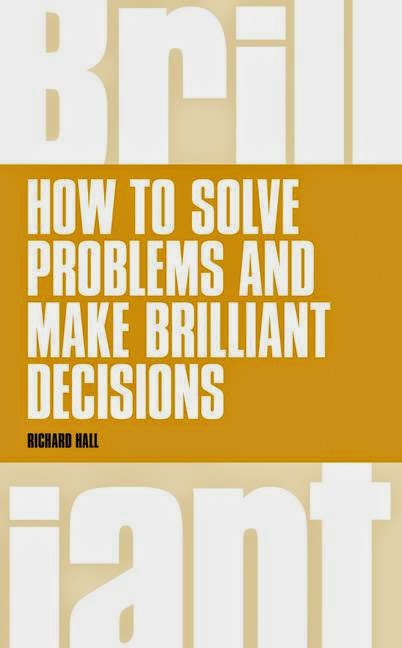
How to solve problems and make brilliant decisions. (Business Thinking Skills that really work) published by Pearson is coming out on November 12th 2014.


How to solve problems and make brilliant decisions. (Business Thinking Skills that really work) published by Pearson is coming out on November 12th 2014

Tuesday, 11 November 2014

IT'S IMPOSSIBLE TO THINK WELL WITHOUT A REASONABLE MEMORY

Today our memory is on our iPad or smartphone. Today children at school are not taught to memorise things. Today we’ve forgotten about our memory (how ironic is that?) Yet memory today is still a vital thinking tool.

Joshua Foer is a journalist and writer (“Moonwalking with Einstein: the art and science of remembering everything” is the book he wrote). He became interested in memory and especially the feats of memory some achieve in remembering hundreds of numbers in sequence or the cards in several packs of cards.


So he visited the USA Memory Championship where his interest deepened. So much so that in 2006, just out of interest, he trained for and entered the championship.…and he won it. Jonathan Foer became US Memory Champion almost by chance. How? In his book he explains how techniques invented 2,500 years ago still work today.

In around 500 BC the Greek lyric poet Simonides had a wonderful memory.  During the excavation of the rubble of one Scopas' dining hall that had collapsed in an earthquake, Simonides (who’d luckily left before the disaster) was asked to identify each guest killed. Although their bodies had been crushed beyond recognition he successfully finished the task by remembering who was who from their positions at the table before his departure. He used what became known as  the 'memory palace', a system for mnemonics widely used until the Renaissance …when things we needed to remember were printed so our memories weren’t called on with quite the previous urgency.


Imagine a lawyer who can’t cross reference relevant cases. Imagine a writer who couldn’t remember the references that enrich his assertions. You cannot busk when you have poor memory. And in business you occasionally need that memory-friend to remind you of a piece of evidence or of something that needs doing.
One of our biggest problems is that our mind attic is stacked full of rubbish that we don’t need. So, in specific areas we really want to focus on, we need to do a “Spring Clean”. Learn some stuff by heart, put some structure around a subject in which we have a keen interest and see what happens.

Look after this, one of our precious assets. Having a good memory makes us so much more efficient, impressive and productive.

How to solve problems and make brilliant decisions. (Business Thinking Skills that really work) published by Pearson is coming out on November 12th2014.

Monday, 10 November 2014

WE CAN'T GO ON TOGETHER WITH SUSPICIOUS MINDS (ELVIS)

The big word of today is “empathy”. You cannot lead people if you don’t listen to them. You cannot lead people if you don’t put yourself in their position. The most important skill is to be seen to understand them well enough so they follow you willingly and not with suspicious minds


You’ll do this by inspiring them, involving them and thinking about how they think. Don’t just tell them to do something. Get on their wavelength. This is called “altrocentric leadership” (“altrocentric” is the opposite of egocentric) and leaders of today are expected to be good at it….or else.

Any business where there isn’t a high level of trust throughout the team is in trouble.

Unless we can build relationships based on trust, our working lives will be difficult. Christopher Locke in “The Cluetrain Manifesto” describes a vision of the future that most of us would sign up to.  “Imagine a world where everyone was constantly learning, a world where what you wondered was more interesting than what you knew and curiosity counted for more than certain knowledge”.  Yes. I’d sign up to that and also to a world where people forgave each other.

Rodney King was famously beaten up by the LA Police after a high speed car chase in 1991. King had criminal form and was not a blameless individual but his words are noble.  “Please can we all get along ….I mean we’re stuck here for a while…we can sort it out”.


In its simplest form, empathy is what it is to feel like being in someone else’s shoes. We can get empathy through reading a novel or seeing a play. We can “feel” the pain, the rage or the desire and it’s probably impossible for us to torture people if we can empathise with them. And it seems to be unique to human beings since even the most developed primates appear not to empathise.

Looking very briefly at the science, neuroscientists like Marco Iacoboni have argued that mirror neuron systems in the human brain help us understand the actions and intentions of other people by quite simply mirroring what other people do. He argues that mirror neurons are the neural basis of the human capacity for empathy which is the very key to our understanding the actions of other people. In the business world the importance of this is self-evident.

How to solve problems and make brilliant decisions. (Business Thinking Skills that really work) published by Pearson is coming out on November 12th 2014

A PLEA FOR RECOGNISING REAL TREASURE

I am not one for nostalgia. The allure of steam trains, pipe smoking and warm beer seems to me massively overrated. UKIP may look fondly backwards but hankering for the past doesn’t create a useful platform for developing the future. Indeed almost everything about the present seems to me a massive improvement - from restaurants to transport to houses everything has simply got cleaner, cheaper and more efficient.


But three times this week I felt a little twitch of affection for long lasting treasures which were they not here we’d be really sorry.

The BBC is obvious enough but the way this organisation is currently reinventing itself is astounding. Dr Who was always good but now it’s reaching Shakespearian levels, similarly Sherlock which has an intellectual power and narrative drive we see seldom except in Stoppard.


And it stretches to C-Beebies - in my days the poncy-voiced lady said accusingly “are you sitting comfortably? Then I’ll begin”. She terrified me. Even John Humphrys has become human on the Today Programme as Cherry Owen in Under Milk Wood asking Mrs Cherry Owen (played by Cerys Matthews) to “give us a kiss”. This, after being called a “silly sausage “by Johnny Rotten in an interview. What fun. What a brilliant apostle for change “Auntie” has become.


And then the Co-op dubbed a joke company following the escapades of the Reverend Flowers and the departure of top management. But you know something? Following the Tesco story and the way the city is walking all over our grocers something stands out. The Co-op may be flawed and foolish but at least it’s authentic in its foolishness. It’s like the Archers full of humanity not behaving like a crooked MBA. Its latest advertising for its bank (proof its feet are made of damp clay) - “ethics, values and a tattoo parlour” is dreadful.

Beware a person who says “...trust me. I’m honest”. But beware a London ad agency for leading the good old Co-op down the smooth ad campaign route. The Co-op is authentic, real, has values and some great products. Focus on the facts and the stories but not in glossy ads. The Co-op is not nor should ever be glossy. But I still it love it warts and all.


And finally people: the diversity I recently saw in Shoreditch which more resembled New York than the London of cosy Soho. Or the laconic conversation I had in a Brighton Lidl about the weather with a quite large lady whose basket seemed alarmingly full of pies.

The Treasury has confirmed what we lovers of immigration have always known (immigration, by the way, creates what has always made the country we live in what it is- a brilliant mish-mash of talent, diversity and resourcefulness.) The Treasury news is this: immigrants bring a net £20 billion to the economy.

£20,000,000, 000 - thank you.


The BBC, the Co-op and our people - human, imperfect and brilliant. We are so lucky.

Sunday, 9 November 2014

ROAD RAGE AND BOARD RAGE BOTH LEAD TO ACCIDENTS

We all lose it. You know that suppressed boiling up inside which can be best dealt with by getting very, very angry and metaphorically (or literally) cutting someone up. Research shows this kills people if you’re driving and kills creativity and clear thinking if you’re in a meeting.

But when you feel great, alert, are happy and at your best you’ll perform better. Good mood equals good performance. Yes, it’s really that simple.

Yet the naysayers and preachers of doom would have it that good creative thinking is best achieved in a world of suffering. This is La Boheme speak - frozen tiny hands and all that.


The thesis is that after he cut off his ear Van Gogh really got going, that Jane Austen suffered in spinster frustration and that Beethoven got better the deafer he got. Human beings survive misfortune in an admirably robust way to be sure but masochism is not the elixir of clear thinking.

My life has been full of seeing futile rage - a crazed executive so angry he was unable to drive out of the car park and reversed at high speed into a wall and then forward into another one. A creative director in an advertising agency hurling a chair - this showed he cared passionately I suppose. Or the executive from a major department store whose motto “when the going gets tough the tough get going” suddenly seemed meaningless as, failing to get the answer he wanted in a phone call, he ripped the phone from the wall and hurled it from a fifth floor window.


This is the stuff of Monty Python.

If you want to have a good day be in a good mood in a place in which you feel comfortable and where a team is committed to trying to solve the problems and exploit the opportunities not blame others or God or bad luck on things not being quite as they’d like.

It’s so much easier being in a good mood.

How to solve problems and make brilliant decisions. (Business Thinking Skills that really work) published by Pearson is coming out on November 12th 2014

Saturday, 8 November 2014

IF WE CHOOSE OUR BRAINS CAN GROW, NOT DIE SLOWLY

Most depressing of all for me when I started researching my book was the realisation that no one still really knows that much about how the brain works (except for this analogy which I rather like: compared to the human brain the computer is as mundane as a can-opener.)  

But the computer brain plus a human being’s brain, well that’s another story. The human problem is this: we’re told that our brain cells are dying off at the rate of knots. So as I sit here writing this blog those little blighters are lining up at the mental crematorium in droves. That’s why my writing could in theory get worse and worse as time passes. Worse and worse……


But here’s the good news. Our brains can actually grow too. Research shows that taxi drivers’ brains grow as they do the knowledge – yes, their hippocampuses actually get bigger. The same is true with violists where the part of the brain that operates their nimble fingers of their left hand, grows. Ditto with ice skaters and their sense of balance.

Carol Dwek is Professor of Psychology at Stanford University and her book “Mind-set” is regarded as seminal in its exploration of mental motivation. It’s not only good on this it also talks persuasively about fixed and growth mind sets. We need the latter if we are to really grow our skills. As she says of people with ‘growth mind sets’: “They don't necessarily think everyone's the same or anyone can be Einstein, but they believe everyone can get smarter if they work at it.

It gets better. There’s strong evidence that as you get older you can get actually more creative.

And writers can write better and better. For example Hilary Mantel is in her 60s; Donna Leon in her 70s: Daniel Kahneman in his 80s and PD James in her 90s.


Daniel Kahneman in action (above) proves it. That the bottom line is simply this. You can train your brain.
And it’s about time we all started doing that so when people ask us “what do you think?” what comes out of our mouths is a considered, thoughtful and useful reply that people listen to and think about themselves.

How to solve problems and make brilliant decisions. (Business Thinking Skills that really work) published by Pearson is coming out on November 12th 2014

Friday, 7 November 2014

UNBLOCKING YOUR BRAINS

We’ve all heard about “writer’s block” the equivalent of an actor drying on stage. But when we have a thinking block at work it’s even more serious. “What do you think?” they ask and the truth is you aren’t, can’t and have forgotten how to. Relax. The intellectual equivalent of Dyno Rod is here.


You need to remove anything which annoys you, distracts you or diverts your interest. Go back to what we know about that brain of ours. It’s easily put off and it’s inclined to be a bit lazy. This is not a machine, it’s a living mind with a memory bank that’s amazing but deep-down it has a low boredom threshold. And here are three things designed to block it:

  • Task shifting – the extreme form of multitasking that destroys our ability to think properly although not always to do simple tasks. Imagine that you are busy thinking about how to create a document or whatever and someone walks in and says – “can you check that appraisal you did for Maisie.  I think it’s going to cause us problems.” The sirens go off. You drop what you’re doing and Maisie gets all your attention. When you get back to your document your mind is no longer on it. Your thinking is blocked.
  • Time pressure – stress makes us brain-frozen and unable to think clearly. “I need this and I need it now” screams your boss. We are incapable of saying “no” or “sorry it takes longer than now”. So we do a poor job at solving it, get stressed and probably, as we present it, are told by the person who’s demanded it “now” - “thanks - fine…I’ll look at it tomorrow”.  Your thinking is blocked and probably blocked for the rest of the day.
  • Imposing self-control – research shows this uses up a lot of brain-space and is hugely effortful. Research shows being diplomatic, restraining the impulse to argue or remonstrate creates a great deal of mental activity. It’s as if we were discovering that mental braking uses more fuel than mental acceleration. 


Self-control blocks thinking. And this means that in many a meeting there’s very little chance of getting people to think deeply as they grind their teeth and try to stay calm restraining their need to shout “get me outta here,” a need created by the normal tedium of long meetings.

There’s another piece of advice that applies to keeping your thinking equipment in good shape. Be in a good mood. Smile. Enjoy what’s going on around you. Breathe deeply and stay calm. If you want to wrong foot someone - why would you? - try to make them tense. If you want your own fluid intelligence to stay fluid just relax.


How to solve problems and make brilliant decisions. (Business Thinking Skills that really work) published by Pearson is coming out on November 12th 2014