Most of us find it really hard to change our minds once we’ve come to a conclusion even when events seem to suggest we might have got it wrong. It simply goes against our psychological grain. Deep down we’ve invested too much time and effort championing an idea or point of view to lightly discard it.
Well, try this if you’re stuck in your opinion. John Maynard Keynes, the iconic economist, asked “when circumstances change I change my mind. What do you do?”
Another good tip to help open your mind and broaden your thinking is for you to see how easy it would be for you to change your mind about something you believe in. I recently heard a story about the late William Rees-Mogg, a man with a brilliant mind who edited the Times a long time ago. He said that he thought, no he was convinced that a given Times leader should say “x”. When politely told that his grasp of the facts were shaky and that in fact “y” was the case, he said, without pausing for breath - “quite so, which is why we must espouse the cause of “y” for the following reasons”.
Now that response is open-minded, flexible and extraordinarily clever (although some might say cynical).
The human race when it feels well informed tends to overconfidence which leads us to nearly all the economic crises we have. It’s overconfidence not greed that’s the enemy of the bank balance.
We tend to forecast boldly but make timid decisions. Think about this the next time you are sitting in front of your forecast spreadsheet. Most of all think this – does my plan match my hopes, expectations and (most importantly) my resources. I bet it doesn’t.
And finally reserve you hardest questions and spirit of scepticism for those regarded as most clever. Often the cleverest are the most intractable. Iain Martin is a political commentator, and a former editor of The Scotsman and former deputy editor of The Sunday Telegraph. He is the author of” Making It Happen: Fred Goodwin, RBS and the men who blew up the British economy”. It has the immortal line in it: ”the assumption was that the ‘new thinking’ made the world safer because it had originated from such clever people.”
In a messy, paradoxical world, nimble mindedness matters more than ever.
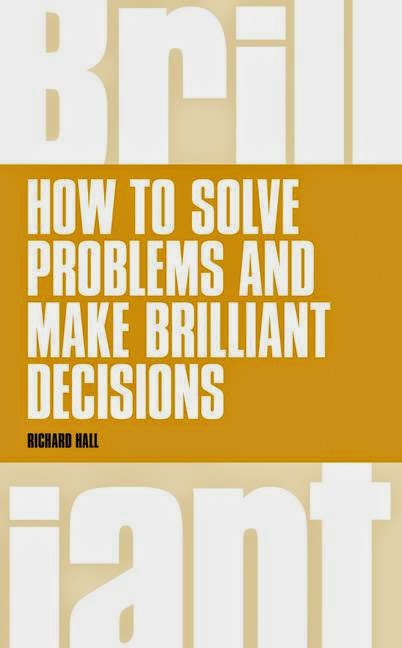
How to solve problems and make brilliant decisions. (Business Thinking Skills that really work) published by Pearson is coming out on November 12th 2014.
How to solve problems and make brilliant decisions. (Business Thinking Skills that really work) published by Pearson is coming out on November 12th 2014
Showing posts with label The Times. Show all posts
Wednesday, 12 November 2014
CHANGE YOUR MIND WHEN THINGS AROUND YOU CHANGE
Labels:
changing minds,
economist,
Fred Goodwin,
Iain Martin,
John Maynard Keynes,
Richard Hall,
Richard Hall author,
The Times,
William Rees-Mogg
Posted by
Richard Hall
at
08:30
Monday, 4 November 2013
DON'T BE FRIGHTENED OF FEAR
Well, that’s easy to say but harder to do.
It was on Wednesday that I got really angry the Times for its smug insensitivity. They’d run a piece about “glossophobia” – that’s the fear of public speaking. As someone who helps people with this problem I feel sympathy with anyone who suffers from it.
So what made me cross was not the news piece on page 5 (of which more in a second) but the leader – yes they actual wrote a leader about it – which said it was not obvious why people should feel anxious about public speaking. Try talking to the 75% of people who do feel bad about it. Even Steven Spielberg said he thought it would be the next topic on which he’d do a frightening film.
The Times leader writer doesn’t get that.
Nor did the Editor of the Times either seem to get that his leg was being playfully pulled. The piece on page 5 winningly headlined “Speaking in public ranks worse than death for most” had been derived from a dodgy piece of promotional research by OnePoll who describe themselves as “creative researchers” and to go a step further as the “pulse of the people”.
Creative research like creative accounting may need to be treated a little sceptically.
In their research fear of public speaking came ahead of being buried alive and death as something to be avoided. Holes in doughnuts and woolly jumpers were regarded as pretty frightening too. Women were more frightened of public speaking than men. And dogs were absolutely incapable of doing it at all (I made that up.)
I want to consider this “pulse of the people” idea.
52% of people think cupcakes are a bit rude (squashy like well you know…) and breadsticks are hardly ever bought by men (penis envy). Ed Miliband is regarded as a sex symbol in Manchester (those eyes staring with unrequited passion) and research proves Pepsi makes you fart whilst Coca Cola doesn’t. And 90% of Times readers believe what they read.
This is not a hallucination: this is the pulse of the people.
But cutting through all this I strongly believe that teaching people to speak with confidence and with wit and charm is as important as teaching them to read.
But not as important as Britain’s most serious newspaper stopping behaving like a stand up comedian.
Labels:
dogs can't do it,
fear of public speaking,
public speaking,
Steven Spielberg,
The Times
Posted by
Richard Hall
at
06:00
Monday, 15 October 2012
IT'S NOT JUST THE WAY YOU TELL THEM THAT MATTERS
Aren’t party conferences incredibly old fashioned? They’re the Routemaster buses or Frank Carsons of communication. Great for the hospitality business but that’s as far as it goes.
As I watched bits of Danny Alexander – good grief - and the four party leaders (I include Boris in that line up) I began to wonder what had happened to the power of argument.
Philip Collins of the Times is the seer of “what they’re really saying”. And sometimes finds more going on in a speech than I do.
Ed Milliband got praised for speaking for 70 minutes without notes. What’s the big deal? It’s the content that really matters.
Man or waxwork?
The obsession about speaking without any prompts is weird. Margaret Thatcher read her speeches and so did Tony Blair.
Most of the speeches are far too long and aim to be as blandly uncontroversial as possible ….but we live in deeply controversial times. They need to be edgy.
What seems clear (especially as we discover the murky secrets of Lance Armstrong, Jimmy Savile and apparently a whole host of DJs) is appearance was everything and minor misdemeanours like cheating or sexual exploitation, even rape, were OK if you were otherwise a good guy….. Yes, that’s just Adolf’s little way….he did a lot for the economic growth of Germany – good guy in very many ways.
I think we are all losing our critical faculties and are judging speeches by the performance not the thoughts contained within them - although some have got under a few skins.
Boris is the most extreme example, undoubted comic that he is.
I found Max Hastings words telling “I would neither trust my wife or my wallet with Boris” although, if I were Max’s wife, I might have something to say about this.
www.colourfulthinkers.com
Labels:
boris johnston,
Ed Milliband,
Frank Carson,
Jimmy Savile,
Jimmy Saville,
party conference,
Phil Collins,
Routemaster,
The Times
Posted by
Richard Hall
at
06:00
Tuesday, 23 November 2010
AUSTERITY AND HILARITY
I was wondering why I was in such an extremely good mood. It’s not the news - a mining disaster in New Zealand, the catastrophe of Haiti and the humiliation of the Irish (as the Times put it.)
At first I put it down to the impending ho, ho, ho of Christmas – the first time in years I’ve felt that surge of goodwill (is it flu? No it’s goodwill – an acute case of it.) It could be the effect of young grandchildren and great nieces but there’s more to it than children’s sense of wonder.
I genuinely believe if we set our minds to it we can be a lot more cheerful, productive and effective. Being in a good mood is as much up to us as it is to outside events. As Jack Welch put it (former head of GE) “determine your own destiny or someone else will.”
Which takes us back to the Irish for whom I feel a genuine affection and sympathy – they’ve been stuffed by the speculators as so many of us have been in the past. Do not confuse speculation with entrepreneurialism. The latter is about making calculated adventurous moves – like a new product launch – the former about betting the house and all your neighbour’s houses on red.
There’s only one way out – a dose of austerity which I’m afraid will taste like a powerful Bloody Mary – and a decision to laugh in the face of the doom mongers. As the recently spanked Lord Young said “honestly, you’ve never had it so good” Naughty Lord! The truth is that the way we really feel is in the mind not in the wallet.
And right now I’m feeling great. Positive, on song and up for it.
And they say it might even snow later this week.
Happy Christmas.
At first I put it down to the impending ho, ho, ho of Christmas – the first time in years I’ve felt that surge of goodwill (is it flu? No it’s goodwill – an acute case of it.) It could be the effect of young grandchildren and great nieces but there’s more to it than children’s sense of wonder.
I genuinely believe if we set our minds to it we can be a lot more cheerful, productive and effective. Being in a good mood is as much up to us as it is to outside events. As Jack Welch put it (former head of GE) “determine your own destiny or someone else will.”
Which takes us back to the Irish for whom I feel a genuine affection and sympathy – they’ve been stuffed by the speculators as so many of us have been in the past. Do not confuse speculation with entrepreneurialism. The latter is about making calculated adventurous moves – like a new product launch – the former about betting the house and all your neighbour’s houses on red.
There’s only one way out – a dose of austerity which I’m afraid will taste like a powerful Bloody Mary – and a decision to laugh in the face of the doom mongers. As the recently spanked Lord Young said “honestly, you’ve never had it so good” Naughty Lord! The truth is that the way we really feel is in the mind not in the wallet.
And right now I’m feeling great. Positive, on song and up for it.
And they say it might even snow later this week.
Happy Christmas.
Labels:
austerity,
Bloody Mary,
Christmas,
Haiti,
Irish,
Jack Welsh,
Lord Young,
New Zealand,
The Times
Posted by
Richard Hall
at
06:07
Tuesday, 16 November 2010
THE NEW WORLD OF BRAND VALUES
I’ve been spending time recently thinking about the brands of the future and what they’ll look like. This has been helped by a recent survey.
The Times of October 15th published the Populus/YouGov list of the most influential brands. I’ve compared 2007 and today to see what’s changed in the “top ten”.
In 2007 we were in the Vienna days of those good times before the economic war, so the reputational demise of Goldman Sachs and McKinsey since then isn’t so surprising. Virgin, M&S and Tesco are perhaps punished for their failure to keep up with the way people see the times and Microsoft and Tesco, I suspect, for being so big and bullying. But apart from John Lewis and the Co-op the “go-go” brands are young, all post war creations. Ten years ago half of them would have been establishment brands like Coca-Cola, Cadbury and Ford.
The big news is from the “we stand for an attitude to life and employees – employees always coming first” – John Lewis and the Co-op. Look at the Innocent website and you’ll see that they live in this same world of celebrating its employee/partners and its ethics (yes – good for them – they actually use that word).
The somewhat unworldly Co-op evoking as it has done a patronisingly sniffy “room-for-improvement” response from many marketers proves the power of staying true to principles and putting substance before style.
So welcome to real and sustainable brand values if you want to be taken seriously and maybe great product values too.
The Times of October 15th published the Populus/YouGov list of the most influential brands. I’ve compared 2007 and today to see what’s changed in the “top ten”.
| 2010 | 2007 |
| Apple | |
| Apple | |
| John Lewis | Tesco |
| Amazon | John Lewis |
| Microsoft | |
| Microsoft | Virgin |
| Innocent | M&S |
| Co-op Group | Goldman Sachs |
| Co-op Bank | McKinsey |
| BSkyB |
In 2007 we were in the Vienna days of those good times before the economic war, so the reputational demise of Goldman Sachs and McKinsey since then isn’t so surprising. Virgin, M&S and Tesco are perhaps punished for their failure to keep up with the way people see the times and Microsoft and Tesco, I suspect, for being so big and bullying. But apart from John Lewis and the Co-op the “go-go” brands are young, all post war creations. Ten years ago half of them would have been establishment brands like Coca-Cola, Cadbury and Ford.
The big news is from the “we stand for an attitude to life and employees – employees always coming first” – John Lewis and the Co-op. Look at the Innocent website and you’ll see that they live in this same world of celebrating its employee/partners and its ethics (yes – good for them – they actually use that word).
The somewhat unworldly Co-op evoking as it has done a patronisingly sniffy “room-for-improvement” response from many marketers proves the power of staying true to principles and putting substance before style.
So welcome to real and sustainable brand values if you want to be taken seriously and maybe great product values too.
Labels:
Amazon,
brands. Apple,
Facebook,
Google,
John Lewis,
Tesco,
The Times,
Twitter,
Virgin
Posted by
Richard Hall
at
21:48
Subscribe to:
Posts (Atom)


