Today our memory is on our iPad or smartphone. Today children at school are not taught to memorise things. Today we’ve forgotten about our memory (how ironic is that?) Yet memory today is still a vital thinking tool.
Joshua Foer is a journalist and writer (“Moonwalking with Einstein: the art and science of remembering everything” is the book he wrote). He became interested in memory and especially the feats of memory some achieve in remembering hundreds of numbers in sequence or the cards in several packs of cards.
So he visited the USA Memory Championship where his interest deepened. So much so that in 2006, just out of interest, he trained for and entered the championship.…and he won it. Jonathan Foer became US Memory Champion almost by chance. How? In his book he explains how techniques invented 2,500 years ago still work today.
In around 500 BC the Greek lyric poet Simonides had a wonderful memory. During the excavation of the rubble of one Scopas' dining hall that had collapsed in an earthquake, Simonides (who’d luckily left before the disaster) was asked to identify each guest killed. Although their bodies had been crushed beyond recognition he successfully finished the task by remembering who was who from their positions at the table before his departure. He used what became known as the 'memory palace', a system for mnemonics widely used until the Renaissance …when things we needed to remember were printed so our memories weren’t called on with quite the previous urgency.
Imagine a lawyer who can’t cross reference relevant cases. Imagine a writer who couldn’t remember the references that enrich his assertions. You cannot busk when you have poor memory. And in business you occasionally need that memory-friend to remind you of a piece of evidence or of something that needs doing.
One of our biggest problems is that our mind attic is stacked full of rubbish that we don’t need. So, in specific areas we really want to focus on, we need to do a “Spring Clean”. Learn some stuff by heart, put some structure around a subject in which we have a keen interest and see what happens.
Look after this, one of our precious assets. Having a good memory makes us so much more efficient, impressive and productive.
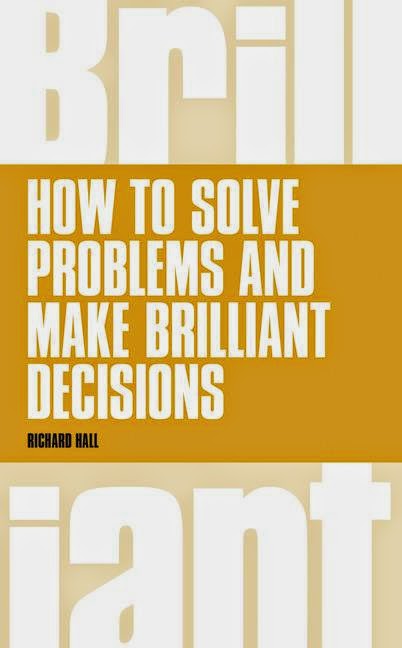
How to solve problems and make brilliant decisions. (Business Thinking Skills that really work) published by Pearson is coming out on November 12th2014.
Showing posts with label ipad. Show all posts
Tuesday, 11 November 2014
IT'S IMPOSSIBLE TO THINK WELL WITHOUT A REASONABLE MEMORY
Labels:
Apple,
ipad,
memory,
memory tricks,
Moonwalking with Einstein,
Richard Hall,
Richard Hall author,
USA Memory championship
Posted by
Richard Hall
at
08:30
Monday, 31 October 2011
THE STEVE WAY OF LOOKING AT THINGS
As I spent my week puzzling over the disadvantages of democracy – all talk and no action – the idiotic spectacle of the Italians with their trousers round their economic ankles - the last writhings of capitalism furtively displayed by that shameless increase in pay of senior executives in the UK of 49% year on year and the split in the church over how to handle St Pauls from the Bishop of London’s robust approach “onward Christmas soldiers marching as to war” (viz torch the tents) to the more pacifist “turn the other cheek” - the view (yet again) is the Anglican church has made itself an idiot (together with the Catholic church in those leafy avenues of paedophilia Ealing).
What would Steve Jobs have done? Steve the hero of our generation, and undoubtedly a genius techno-artist.
He’d have simplified everything.
He’d have taken Greeks, Portuguese, Italians and Spanish into his legendary lift and fired them, reduced Angela and Nicolas to torrents of tears by, as Jonathan Ive said, identifying their sensitivities and weaknesses and ruthlessly attacking them where it hurt (which being so sensitive himself he was adept at doing), disbanded all the committees in Brussels and created the greatest currency ever - the iPo.
Trouble is it would have led to war because countries are disparate cultures which can’t be conformed like Apple and because people just aren’t as perfect and clonable as things like the iPad and the Mac keyboard can be, so beautiful that Steve wanted to lick it. Steve himself was clearly not a very nice man. He seems to have been a sadistic bully and full of anger and contempt for others. He was the sort of person who wouldn’t say “after you” as you stood by a lift together (but wouldn’t need to as the thought of being “Steved” in a lift should have been enough to make you flee.)
But he taught us a lot of things and sometimes genius maybe forgiven its bad table manners. He taught us bullshit is bullshit, mediocre isn’t good enough so try again, obsession with detail is good and small is beautiful. Apple always felt small and focused.
Unlike Shell, CitiGroup, Kraft, BA and the EU which I always see as big and sluggish, process-driven, old fashioned and vulnerable. Out-of-condition Goliaths (“Sorry Mr G you need a life style change.”) So when I kept hearing through the week “does Britain want to become a second class power?” it was like hearing “does Leeds United want to be a second class football team?” But we are and it is.
We need to be the best we can be at what we can excel at. Steve turned a bankrupt Apple into one of the most successful companies in the world in 20 years just by focusing on that. If he’d been an average UK businessman he’d have sold to Microsoft years ago. Or he’d, as Britain, have become a fully- fledged member of the EU.
But if you give up your independence you can’t live your dream.
Now get into that lift and let’s talk.
Labels:
Anglican Church,
Apple,
Bishop of London,
economic,
ipad,
pay increase,
sadistic,
senior executives,
St Paul's Cathedral,
Steve Jobs,
tents
Posted by
Richard Hall
at
06:16
Monday, 17 January 2011
WHAT A WASTE...
Seamus Smyth is one of the brightest people I know. He used to work for Shell. Now he thinks a lot and is a kind of intellectual social entrepreneur. He also has very long hair which I miss in the deep thinkers of today who tend to favour baldness. He said this when I asked him what 2011 and beyond held in store:
“The mission to give people more of what they actually want and need, rather than what people make will intensify to a degree that we’ve never seen before as WASTE will become the world’s common enemy.”
I recalled seeing a piece in Fast Company about the iPad wars noting that as many as 80 tablet devices were debuting at this year's Consumer Electronics Show (CES).
Seamus is right. Over in China, Taiwan or Japan factories employing thousands of people are working away, trying to keep busy and screaming at their sales forces to sell more. What they make is irrelevant. It’s sheer and utter madness.
The voice of marketing is being deafened by the sound of production making “stuff” – most of it not quite what people want. The God “growth” is what fills the minds of City analysts and the media. So Tesco must be trembling in shame for its appalling 1% yoy decline for quarter 4 2010 whilst Sainsbury is a brilliant A* student because of its +3% growth. Please.
We are wasting a lot of things right now:
· Resources - the intelligence to rein in on making the unsellable
· Space - the unneeded buildings we could flatten and turn into parks
· Our talent - the bright young minds that will remain unemployed and losing the will to think when we could be coaching them into being thoughtful citizens of the new world
· Day to day waste - all manner of activities in big companies that use up time and money to no good effect (getting people at the coal face of any business to remove waste would save billions and they would be savings not cuts)
· Hubristic plans - expenditure on big and irrelevant capital projects – like the high speed train link. It takes 2 hours Euston to Liverpool by train. Who needs faster than that?
The penalty of the quest for economic growth is extravagance and waste. In a so-called age of austerity it’s a brilliant moment to reduce what you do that has no obvious beneficial effect and to spend a bit more time thinking.
Seamus is right. Waste is the common enemy.
Labels:
baldness,
China,
consumer electronics show,
Fast Company,
ipad,
Japan,
Shell,
tablet device,
Taiwan,
Waste
Posted by
Richard Hall
at
06:00
Subscribe to:
Posts (Atom)


