Showing posts with label Pearson. Show all posts

Monday, 8 December 2014

MY LATE NIGHT SKYPE INTERVIEW

It was 8.30pm after a long day.

And I was live…crackle, hiss and splat!


Wade Danielson is based in Texas and has launched the Entrepreneur’s Library - so far there are 106 Podcasts by authors whose books might be of interest to entrepreneurs - he’s doing these interviews at the rate of five a week.

And he asked me to do one on my “paradigm shifting” book (there’s a big opportunity for you in marketing and flattery Wade).

So dip into this.

Apart from sounding as though I’ve been imprisoned in a wonky tumble drier and the fact that I’m talking too fast and in a rather unstructured and impassioned way - system one in my brain at full tilt - it’ll do. It’ll have to.  If nothing else I’ve learnt how to do it next time.

Ironic isn’t it that with every presentation you (or I) do it’s only when you’ve done it you actually realise how you should have done it.


Friday, 21 November 2014

CREATIVITY GETS VERY EASILY BLOCKED. BEWARE!

When it comes to creative thinking most of us get blocked by inner voices asking “what if?” or posing the question “just suppose x happens...” The fear of rejection looms larger than the anticipation of success and so long as it does we are driving our creativity with the handbrake on.

And here’s the hardest question of all that I once saw – “if whatever you decide to do next could not fail what would that be?”  The terrifying thing is you have things like “create world peace” and “end of all disease” to beat and then you wonder whether either of those might have an explosive impact on  population growth so terrible that the expression “be careful what you wish for” would come home to roost rather smugly. Creativity needs a bit of grit in the oyster to achieve really great results. Human beings handle perfection uneasily.


In fact most people are lacking in confidence when it comes to creative thinking. They think they are reasonably intelligent but weak at creativity. In self-assessment tests respondents scored themselves at 7/10 for intelligence but only at 4.5/10 for creativity. In removing the most obvious blocks we have to realise that our brain has a habit of lying to us. Yes inside our heads is a congenital fibber.

In research tests where people are asked to solve a problem involving moving a weight from position A to position B and the answer is to swing the weight on a rope pendulum (an obvious solution once seen) they will deny having had any help to get there despite the questioner brushing the rope and giving strong hints.

Yes, I’m sorry to say the creative muscle in our head tells great whoppers. It’s also a brilliant film editor cutting and editing our memory so our “honest” recollection of history is (how shall I put it?) especially favourable to us. We are heroes in our own memories. We are tolerant, kind and liberal. By the way if you want to find out what you really are deep down try the “Implicit Association Test” (implicit.harvard.edu/‎). You may be a little surprised.

Creativity is massively impeded if we meet a cynic. There are a variety of terrible expressions cynics have mastered which act like a right hook on our ability to think lucidly, imaginatively and come up with ideas:


 “Well, anyway…”, “in the meantime…”, “mind you…”, “let me think about it”… (that means “no” in plain English), “suppose for the sake of argument…”, “with the greatest respect”…, “that’s all very well but…”

Assumptions stifle creativity; assumptions that our ideas won’t meet approval, that the audience won’t laugh or assumptions that the worst will happen.  This also happens in institutionalised bureaucracies where the assumption exists that creativity is a bit flippant and “not for us.”

How to solve problems and make brilliant decisions. (Business Thinking Skills that really work) published by Pearson

Thursday, 20 November 2014

OUR EMOTIONS DRIVE OUR DECISIONS


We know how important our emotions are - that our instincts are the powerful engine of our thinking. We think we are coldly rational whilst it’s our intuition in charge.  This makes for a more interesting but less predictable life. Decisions are reached by our working hard trying to get emotions and logic aligned. But here’s what’s really going on.

Our sub-conscious is making the decision that is fed to our conscious and there’s a time lag of ½ second between the two (Benjamin Libet started this work at the University of California over 50 years ago). This suggests that when this happens the decision we are seeking arrives in our mind (unannounced as it were). So we’d do well to think “let’s question again whether this is the right or the only decision.” In other words rigorously question ourselves.


A key to good thinking is always going to be to strengthen our resistance to taking our own feelings for granted. Trust your gut but then say: “hang on…can I find a better solution…is this necessarily the best and only decision?” Never dismiss first impressions but park them as a useful start and then re-examine all the data you can. Life needn’t be a lottery if you’re smart (but don’t tell Camelot that).

When we’ve decided what we need to do we still have to carry others with us. Marketing our decisions is the really hard bit, much, much harder than making the decision itself.

Because a decision isn’t going to be a real decision until it gets buy-in.

Emotion drives decisions. Emotion conditions receiving decisions. This is why presentation matters. How you wrap up a present says how much you care. How you deliver a message is critical to how it’s heard.


if a surgeon tells you either that a given procedure gives you a 10% chance of dying or tells you that it gives you a 90% chance of surviving (and rationally you know that these are exactly the same thing) the chancGeorge Bush, es are you’ll see the latter option as being much superior. (And, unsurprising, in research the comparative approval scores are respectively 50% and 84%.)

Not everyone thinks making decisions is that hard. Here’s what George Bush said: “I don’t spend a lot of time taking polls around the world to tell me what I think is the right way to act. I’ve just got to know how I feel.”

I hope, if nothing else, that remark underlines just how important rigorous thinking really is when making decisions. Emotion is fine. Trust your gut. Yeah but shucks there must be more to the most important job in the world than that.
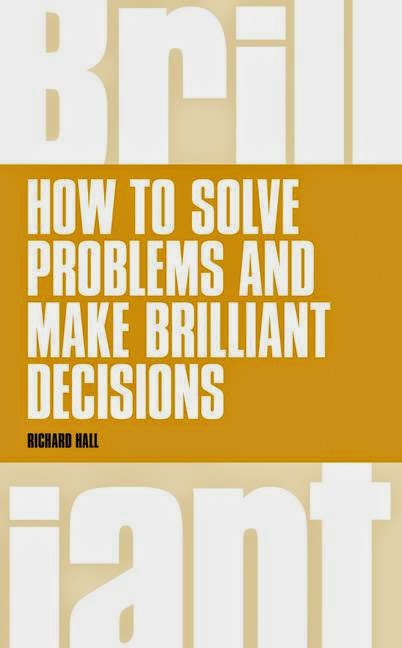
Richard Hall's book "How to solve problems and make brilliant decisions"

How to solve problems and make brilliant decisions. (Business Thinking Skills that really work) published by Pearson

Tuesday, 18 November 2014

TEN THINGS TO AVOID WHEN MAKING DECISIONS

I wish I’d known all these earlier in my career. Decision making which varied from the timorous to crassly rash could have been avoided.

Avoid thinking like an ass. An ass was dying in the desert equidistant from food and water. Unable to decide which way to go to satisfy his needs he died. If you know that you have to make a decision and it’s a 50:50 choice about what to do, assess both options and then make a decision. Do not be an ass.


Avoid making up your mind prematurely. The single most common cause of bad decisions is deciding what to do before hearing all of the evidence. It’s hard to resist as our instincts are at work before we are even aware of it. Listen to what the whole story is first.

Avoid inappropriate prevarication. “Stop and think” is good advice. But in a crisis or if you’re in the middle of a motorway with traffic hurtling towards you, rely on your instincts, trust your gut and get a move on.

Avoid being that man in the ivory tower. Do not decide without conferring from others if you want good results from those around you.

Don’t be a dictator. The Duke of Wellington, who led the British Army at the Battle of Waterloo in 1815 became Prime Minister 13 years later. Asked by a friend after his first cabinet meeting how it had gone he said:-  “Extraordinary thing but I gave them their orders and they wanted to sit around and discuss them.” The day of the autocrat is over.


Avoid being hungry. As a young man Daniel Kahneman worked in Israel with the Israel Parole Court. He found judges were more likely to allow parole after lunch than before they’d eaten. So do not make big decisions on an empty stomach.

Avoid small numbers. The use of anecdote and small samples “The law of small numbers” is bad practice.  How often in the middle of a seriously argued case will you hear someone who’s otherwise very sensible say “well that’s all very well but I recently saw…”?

Avoid being smug about success. Success can confuse thinking and decision making. We remember when we made a great call that really paid off. We always (being human) want to repeat that.

Avoid reducing your chances. Making decisions when you are very tired, jet lagged, drunk or are working in a foreign language is best avoided

Avoid shortcuts, sleeping on the job and short changing – the brain has a brilliant way of taking the easy way out. By:

  • Asking ourselves a different,  easier question
  • Or moving on to something we like doing not this difficult thing
  • Or going  into mental hibernation like  “I’ll sleep on it”
  • Or failing to look hard enough. Magicians rely on our faulty eyesight. We see pretty clearly dead in front of us – things that are in the spotlight – but there’s darkness on the periphery of our vision.


How to solve problems and make brilliant decisions. (Business Thinking Skills that really work)
published by Pearson

Monday, 17 November 2014

BIG DATA IS BRILLIANT

Everyone is talking about “Big Data.” It’s transforming the way we think and analyse stuff. We have discovered that correlation has become more important than causality. That what happens is more important than why it happens. The book by Viktor Mayer-Schonberger and Kenneth Cukier published last year - “Big Data: A Revolution That Will Transform How We Live, Work and Think” is highly recommended.

We know the increase of information is accelerating. For instance all the information and data that currently exists will double in the next three years. With more information we need less exactness. Nowadays the equation 2+2= 3.9 is good enough. We don’t need to be exact if we can see the big

Today social media and CCTV may be more useful research tools than anything else we have. Google Translate has extraordinarily proved to be the best translation service around. The software uses “corpus linguistics” techniques, where the programme "learns" from professionally translated documents, specifically UN and European Parliament proceedings but increasingly from all kinds of documentation – lots and lots of sources – big, big data. (In passing how it is nice that the forest of paper produced by the UN and EU can go to such good use.)


Intriguingly they say the service improved since the linguists they’d hired when they started up (well you would want linguists in a translation service wouldn’t you?) left the business because they wanted linguistic perfection whereas this being a product of big data is not that subtle. This is one of the few examples I’ve come across where big trumps clever.

The existence of robust data obviating the need for the tabloid use of anecdote allows us to spend more time using our brains to think rather than using them as pickaxes to mine for information. Anyone who tells you that guessing is more fun than knowing hasn’t come across the thrill of irrefutable information.

Its application is critical in the medical field where the speed of big data via social media allows a disease to be detected before it becomes an epidemic (and because detected early it can never become a pandemic.) We hear less about avian flu today in part thanks to big data.


So the big data  boom is happening and we have however sufficient glimpses of the future to see we’ll be doing less intellectual “grunt-work” in the future and more intellectual “stunt-work”.
To be sure there can and will be issues of data protection that arise from increasing access to data but the excitement lies in big data allowing us the freedom to think more clearly.

How to solve problems and make brilliant decisions. (Business Thinking Skills that really work) published by Pearson

Monday, 10 November 2014

WE CAN'T GO ON TOGETHER WITH SUSPICIOUS MINDS (ELVIS)

The big word of today is “empathy”. You cannot lead people if you don’t listen to them. You cannot lead people if you don’t put yourself in their position. The most important skill is to be seen to understand them well enough so they follow you willingly and not with suspicious minds


You’ll do this by inspiring them, involving them and thinking about how they think. Don’t just tell them to do something. Get on their wavelength. This is called “altrocentric leadership” (“altrocentric” is the opposite of egocentric) and leaders of today are expected to be good at it….or else.

Any business where there isn’t a high level of trust throughout the team is in trouble.

Unless we can build relationships based on trust, our working lives will be difficult. Christopher Locke in “The Cluetrain Manifesto” describes a vision of the future that most of us would sign up to.  “Imagine a world where everyone was constantly learning, a world where what you wondered was more interesting than what you knew and curiosity counted for more than certain knowledge”.  Yes. I’d sign up to that and also to a world where people forgave each other.

Rodney King was famously beaten up by the LA Police after a high speed car chase in 1991. King had criminal form and was not a blameless individual but his words are noble.  “Please can we all get along ….I mean we’re stuck here for a while…we can sort it out”.


In its simplest form, empathy is what it is to feel like being in someone else’s shoes. We can get empathy through reading a novel or seeing a play. We can “feel” the pain, the rage or the desire and it’s probably impossible for us to torture people if we can empathise with them. And it seems to be unique to human beings since even the most developed primates appear not to empathise.

Looking very briefly at the science, neuroscientists like Marco Iacoboni have argued that mirror neuron systems in the human brain help us understand the actions and intentions of other people by quite simply mirroring what other people do. He argues that mirror neurons are the neural basis of the human capacity for empathy which is the very key to our understanding the actions of other people. In the business world the importance of this is self-evident.

How to solve problems and make brilliant decisions. (Business Thinking Skills that really work) published by Pearson is coming out on November 12th 2014

Sunday, 9 November 2014

ROAD RAGE AND BOARD RAGE BOTH LEAD TO ACCIDENTS

We all lose it. You know that suppressed boiling up inside which can be best dealt with by getting very, very angry and metaphorically (or literally) cutting someone up. Research shows this kills people if you’re driving and kills creativity and clear thinking if you’re in a meeting.

But when you feel great, alert, are happy and at your best you’ll perform better. Good mood equals good performance. Yes, it’s really that simple.

Yet the naysayers and preachers of doom would have it that good creative thinking is best achieved in a world of suffering. This is La Boheme speak - frozen tiny hands and all that.


The thesis is that after he cut off his ear Van Gogh really got going, that Jane Austen suffered in spinster frustration and that Beethoven got better the deafer he got. Human beings survive misfortune in an admirably robust way to be sure but masochism is not the elixir of clear thinking.

My life has been full of seeing futile rage - a crazed executive so angry he was unable to drive out of the car park and reversed at high speed into a wall and then forward into another one. A creative director in an advertising agency hurling a chair - this showed he cared passionately I suppose. Or the executive from a major department store whose motto “when the going gets tough the tough get going” suddenly seemed meaningless as, failing to get the answer he wanted in a phone call, he ripped the phone from the wall and hurled it from a fifth floor window.


This is the stuff of Monty Python.

If you want to have a good day be in a good mood in a place in which you feel comfortable and where a team is committed to trying to solve the problems and exploit the opportunities not blame others or God or bad luck on things not being quite as they’d like.

It’s so much easier being in a good mood.

How to solve problems and make brilliant decisions. (Business Thinking Skills that really work) published by Pearson is coming out on November 12th 2014

Friday, 7 November 2014

UNBLOCKING YOUR BRAINS

We’ve all heard about “writer’s block” the equivalent of an actor drying on stage. But when we have a thinking block at work it’s even more serious. “What do you think?” they ask and the truth is you aren’t, can’t and have forgotten how to. Relax. The intellectual equivalent of Dyno Rod is here.


You need to remove anything which annoys you, distracts you or diverts your interest. Go back to what we know about that brain of ours. It’s easily put off and it’s inclined to be a bit lazy. This is not a machine, it’s a living mind with a memory bank that’s amazing but deep-down it has a low boredom threshold. And here are three things designed to block it:

  • Task shifting – the extreme form of multitasking that destroys our ability to think properly although not always to do simple tasks. Imagine that you are busy thinking about how to create a document or whatever and someone walks in and says – “can you check that appraisal you did for Maisie.  I think it’s going to cause us problems.” The sirens go off. You drop what you’re doing and Maisie gets all your attention. When you get back to your document your mind is no longer on it. Your thinking is blocked.
  • Time pressure – stress makes us brain-frozen and unable to think clearly. “I need this and I need it now” screams your boss. We are incapable of saying “no” or “sorry it takes longer than now”. So we do a poor job at solving it, get stressed and probably, as we present it, are told by the person who’s demanded it “now” - “thanks - fine…I’ll look at it tomorrow”.  Your thinking is blocked and probably blocked for the rest of the day.
  • Imposing self-control – research shows this uses up a lot of brain-space and is hugely effortful. Research shows being diplomatic, restraining the impulse to argue or remonstrate creates a great deal of mental activity. It’s as if we were discovering that mental braking uses more fuel than mental acceleration. 


Self-control blocks thinking. And this means that in many a meeting there’s very little chance of getting people to think deeply as they grind their teeth and try to stay calm restraining their need to shout “get me outta here,” a need created by the normal tedium of long meetings.

There’s another piece of advice that applies to keeping your thinking equipment in good shape. Be in a good mood. Smile. Enjoy what’s going on around you. Breathe deeply and stay calm. If you want to wrong foot someone - why would you? - try to make them tense. If you want your own fluid intelligence to stay fluid just relax.


How to solve problems and make brilliant decisions. (Business Thinking Skills that really work) published by Pearson is coming out on November 12th 2014

Thursday, 6 November 2014

LETS KEEP THINGS SIMPLE

Yes but - and it’s a big BUT - be very careful. Our very human mind finds it appealing to create stories or conspiracy theories where none actually exist. It constantly tries to simplify and find neat patterns and answers.

 It does not appreciate the idea of things happening at “random” but likes to discover patterns and use simplifying devices like runes and rhymes. Here’s one about my book:-

“Just read this book and have no fear, it’ll help you think and change your career“

It’s strange but expressed like that it conveys a possibility of truth that the blunt “read this and get on” will not. The latter sells assertively, the former wraps up the thought in a kind of irrefutable, pseudo-biblical parcel.

Myers Brigg, a system strongly advocated by many does just that too. For those who don’t know about it it’s the Personality Checking System beloved of HR people. If you haven’t been Myers Brigged then you probably haven’t got a personality in the accepted sense of the word. Ironically it identifies around the same number of types of personality as the number of behaviours performed by the Mexican Green Lizard that have been identified by Californian PHD students. That’s 27.


Well I may be perverse but I think there are more than twenty seven personality types. I think it’s the diversity of people and their attitudes and behaviour that makes humanity so fascinating. So, yes, I am very cautious about oversimplification.

The more one studies the brain and the process of thinking the more inappropriate it seems to dumb down and pigeon hole the issues. The brain is so complex, so magical and so surprising that a bit of messiness in describing it seems not only right; it seems to capture the ability and indeed the need of the brain to juggle and dance in a bizarre way.


In fact Martin Sorrell who runs the advertising giant WPP nailed it when he said:- “The 21st Century is not for tidy minds.”

And now to demonstrate how untidy I can be I’m going off slightly, at a tangent, to advocate a principle about sticking to the obvious whilst not oversimplifying.

There are two so-called laws of psychology worth bearing in mind here.  “Occam’s Razor” which espouses simplification (in an acceptable way) in suggesting that it’s the simplest cause of an event that is likeliest to be the true one. Experience would tend to confirm this is generally the case, but with the proviso that the second law of “Occam’s Broom” doesn’t also apply which is the urge to sweep inconvenient evidence under the carpet that seems to disprove “Occam’s Razor”.

How to solve problems and make brilliant decisions. (Business Thinking Skills that really work) published by Pearson is coming out on November 12th 2014

Wednesday, 5 November 2014

A RECIPE FOR INSANITY

I want you to do a simple task whilst driving - multiply 14 by 27. Ha! You can’t do it. Of course you can’t.  Or if you can you’ll be wound around a lamp post by now. Proof that the multitasking myth is just that: a piece of dangerous fantasy. 

Juggling is clever. It’s a skill people get to learn and get better at it but it’s pretty one dimensional. It’s a circus act.  Juggling is for clowns.


The current story is that this new technophiliac generation is being hardwired differently to the rest of us and that they can learn how to do a series of thinking tasks concurrently - like do homework, watch TV, send a text, play a video game and make a phone call. They claim to have seen it happen with their children. They speak of it in awe. All I’d ask is that they take a good, hard look at that homework.

Quite simply, although our brains are wonderful and currently beyond most of our comprehension, we do realise that they aren’t set up to do conscious tasks in tandem. The most successful people blinker themselves and focus (yes I’m forced to use that word I hate) on addressing, thinking about and completing the task in hand.


The most precious commodity in the world is probably “attention” - the capacity to engage one’s mind on a single thing. We are bombarded with messages and stimuli which are exciting and enriching but this also presents us with a big challenge.

We have to make choices about what we do first - hang on - be back in a second I’ve just had another e-mail - yes that’s increasingly our default mode. We’re constantly being interrupted and what we do is give all the attention to the most recent communication for a few seconds until something new happens. Our ability to be disciplined and concentrate will determine our success in thinking.

The psychologists describe this dilemma as being ‘cognitively busy.’ It impairs social behaviour making you more likely to make selfish choices, use sexist language and make superficial judgements.

So if you think multitasking is the sign of a dynamic executive think again - you’d be better off taking a break and sitting quietly and thinking.

How to solve problems and make brilliant decisions. (Business Thinking Skills that really work) published by Pearson is coming out on November 12th 2014

Sunday, 2 November 2014

APRES MOI PLUS CA CHANGE

Wherever I go people tell me that times are terrible, unprecedented and that le deluge is on the horizon. And they tell about a whole load of extraordinary conspiracy theories.

That The Duke of Edinburgh had Diana killed, that the Malaysian Airline was brought down by the CIA, that the Ebola epidemic is the result of a Chinese biological warfare experiment gone wrong, that Nigel Farage is being funded by Qatar, that President Bush arranged the destruction of the Twin Towers in New York, that there was corruption in the Scottish Independence Referendum and the result should have been a “yes” win and that yes indeed the moon is made of cheese.

Nothing is normal in many people’s minds because normal is a bit boring. The human brain is ingenious and complex and loves making up stories. There’s a theory known as Occam’s Razor which states that among competing hypotheses, the one with the fewest assumptions should be selected. In other words the least convoluted simple story is probably right; accident, hard luck or human error - that kind of thing.


The reason we are such a melodramatic bunch is that it feeds our fascination with the macabre. Our brain’s default mode is in fact wandering about not being a forensic Sherlock Holmes’ organ of investigation, problem solving and decision making. We are hardwired to like storytelling and surprises.

Yet the prosaic truth is we have despite the shocks along the way managed to create a well-ordered world where most systems work pretty well with occasional misfiring like an unnecessary war or a deposition of a dictator (hurray!) but with unforeseen consequence (ahh!)

What we find it harder to do is learn from experience and  accept that ordinary can be OK .

How to solve problems and make brilliant decisions. (Business Thinking Skills that really work) published by Pearson is coming out on November 7th 2014

Friday, 31 October 2014

WHY THOUGHTFULNESS BEATS MINDFULNESS

Mindfulness has become the new Pilates or Yoga. People use it to remove stress and doubt. But some find the trouble is it removes ideas and energy as well. “I felt terrific but when they asked where the work was I grinned and said ‘live and let live’. They didn’t seem too impressed.”

 Yi-Yuan Tang (Universities of Oregon and Dalia, China) says of mindfulness “it creates a state of restful alertness …a balanced state of relaxation whilst focusing attention.…” And everything I know about the modern world says this is a great tool. In Davos Gwyneth Paltrow espoused it and even described it as “the new black.”

But…and it’s not a huge ‘but’, but it is a ‘but’….I think content matters…I think people need to focus on energising their brains usefully rather than resting them. If mindfulness is the new black then I think thoughtfulness is the new technicolour. Thoughtfulness is about trying to improve our fluid intelligence, our memory and our attention. It means cutting out multitasking (the most ludicrous practice ever - the next time someone’s texting while you’re talking stop talking.)


It is probable that “attention” is the scarcest and most precious commodity on the planet right now so pay attention, listen and think.

It’s strange that we can imagine thinking is so natural an activity that we don’t have to work at it and focus on how to feed our brains with new ideas and inspiration. We seem currently too worried about how we feel rather than how or if we are thinking powerfully. Our most important tool is being taken for granted. Allan Snyder from the University of Sydney described the lack of creative thinking - thinking at its best thus:

“Imagine a company devoid of creativity and you’re looking at a place…about to die.”

How to solve problems and make brilliant decisions. (Business Thinking Skills that really work) published by Pearson is coming out on November 7th 2014