Showing posts with label Daniel Kahneman. Show all posts
Monday, 13 May 2019
THE RICH LIST ARE PISSED OFF
The front page of the Sunday Times this weekend predicted a ‘catastrophic’ emigration of the rich taking trillions away with them if “Corbygeddon” happened (the paper also published their 2019 “Rich List”). There are reasons why I’m sceptical about the benefits of Jeremy as Prime Minister but I don’t necessarily see slightly increasing taxation on the rich as a major disbenefit. They really have a bit of a cheek. They already find ample ways of avoiding tax so they can go away and live in the Cayman Islands, Guernsey, Monaco or wherever. We shan’t miss them nor, surely, will their departure trumpet the end of the “enterprise economy” as some darkly warn.
Do I envy these rich? Not one whit. Not when two of the richest people I know are both living with clinical depression and are desperately unhappy, beyond doctors’ ability to revive their spirits. Even more horrific is the story of the Rausing family, founders of Tetra Pak, some of whom came to Britain to avoid the high levels of taxation in Sweden (see what happens “Rich-List?). Eva died through a drug overdose and her husband Hans Kristian Rausing's drug addiction was such that he lived with his dead wife for two months in their Eaton Square house before telling anyone. The Rausings for many years topped the Rich List.
I looked at this Rich List today and saw we hadn’t made it – again. But we’d made something else. A reasonable level of comfort, contentment, living close to those we love, with a huge entourage of brilliantly talented, kind and charming friends. On the “Happiness Index” we’d be ahead of most rich paranoiacs.
As Daniel Kahneman observed in his seminal book on thinking, “Thinking Fast and Slow”, human beings are more traumatised by loss aversion than almost anything else. So if you’re rich you spend most of your life terrified someone will take it away. You’ve stopped going to church because people keep talking about getting through the eyes of needles. So you’re leaving for Belize clutching your cash (by the way I love the way that Belize rhymes with sleaze).
Rich seems to mean lonely – stories of Phil Green’s decline and misery from mega-billions to mere hundreds of millions and the opprobrium that’s gone with this decline make me wonder why he doesn’t give it all away and be seen as a nice guy for a change.
Talking of nice guys we saw a French group from Lyon, at the Brighton Festival called the ‘Ensemble Correspondances’ singing music from the court of Louis XII. It was utterly, mind-soothingly perfect. Not a movement, note or nuance out of place. We talked to them afterwards. An entourage of 15 musicians and singers, young, cool and beautiful. I spoke in extravagant, erratic French. They smiled and replied in perfect, nuanced, cultured English.
It occurred to me. Can we get more of them over here and more of the filthy rich over … wherever?
Labels:
Daniel Kahneman,
happiness,
Jeremy Corbyn,
Rausing,
Sunday Times Rich List,
Tetra Pak,
the Enterprise economy
Posted by
Richard Hall
at
09:47
Monday, 18 January 2016
WHY I WANT TO REMAIN BEING EUROPEAN
I’ve just been to Lisbon. I was blown away by how clean, organised and sophisticated it was. The sublimely warm and sunny weather helped. This was one of those basket case economies that after 2008 looked like bringing the EU down. Now exports are up, tourism is up and Portugal like Ireland is on a convincing road to recovery and growth.
My love affair with Europe grows. The thought of Brexit seems as insane as contemplating suicide. What possible sense does resigning from the largest economy and the most exciting culture in the world make? The arguments that the petty bureaucracy of the EU is stifling may be fair but disliking our own HMRC would be a piffling reason for emigrating.
What I love about Europe is that it works. It is so civilised, peaceful and sensible. The Brexit politicians all seem so dreary, aggressive and unambitious. The stay-Ins, for their part, seem inhibited, and too embarrassed to say what they really feel.
Daniel Kahneman’s book “Thinking fast and slow” nailed the realities of decision making…that it was the intuitive System One part of our brains that called all the shots. It makes little sense to seek a list of whys and why-nots for most of us. We are either “Little Englanders” or we are Europeans/Global citizens in our gut. Maybe I should blame my parents who lived the first 15 years of their marriage in Spain for the way I intuitively lean.
It was in Portugal that I read Jean-Claude Piris (he sounds suspiciously foreign or, worse, French the Brexits might say). He used to be Director General Legal Services EU and has written a book called “If the UK Votes to Leave”.
It’s chilling stuff. Leaving the EU is not like resigning from a job or getting a divorce. It will take years of negotiation and the way the EU works they won’t make it easy for us. Our national aircraft will, as it were, be grounded for a very long time.
Our lawyers will have a field day or rather a field year or five redrafting legislation. Our 2million countrymen living in the EU may have a rather unpleasant time especially as Brexit would be accompanied by Britain taking repressive attitudes to the Eastern Europeans. Trade relations with the EU would not just carry on as normal…everything would slow down. Think it’s a bureaucratic morass now? You just wait.
But there’s all the rest of the world to trade with.
Well it’s actually not that simple. Many of our trade relationships are done through the EU so we’d have to redevelop those from a somewhat weaker position. It’s no use comparing our position to Canada, Australia or Switzerland. By leaving the EU we’d be fundamentally changing the status quo.
Whichever way Brexit would be a very long and bloody mess.
And like Millwall FC no one would like us. But unlike Millwall I, and hopefully a majority of Britons, would very much care about that.
Labels:
being European,
Brexit,
collourful thinkers,
Daniel Kahneman,
EU,
Leaving the EU,
Lisbon,
Millwall,
Millwall football club,
Richard Hall
Posted by
Richard Hall
at
08:02
Monday, 21 September 2015
A TRICK OF MEMORY
As you get older your memory seems to worsen but it’s more complicated than the just the onset of senior moments. Quite simply you have much more to remember than someone younger who’s been to fewer places, met fewer people and done less. The attic of your mind or, if you prefer, your “Mind Palace” is crammed to the rafters and finding that name or that reference is hard as it’s lying behind all those memories, thoughts and experiences.
The mind is also good at being a therapist. Forgetting things can often be very helpful. If we could vividly recall as though it were yesterday each root canal procedure we’d had, every embarrassing faux pas and every crisis and tragedy we’d soon become a gibbering wreck. Our mind filters this stuff and sometimes deletes the names of people we actually didn’t like but had felt we ought to have because they were important. Our mental search engine is on our side and it even rewrites history casting us in a better light than we deserved.
Remember that horrible confrontation with a mugger who was about to hit you when you cried: “don’t - please don’t”, and at that moment a passer-by intervened and drove him off. In the recut version of the play you smite the beastly ruffian with one blow of your fist and it is he who cries in a quavering voice “don’t please don’t, please don’t hit me again” and you laugh and send him on his way. Yes!
Daniel Kahneman in his epic “Thinking fast and slow” describes the distorting power of memory and how we can decide, if we choose, that a favourable reconstruction of history makes us happier people. If we can only remember things as they were as vividly as if they’d happened today we should never forgive. The Irish Peace Agreement, the cordial relationships we have with Germany and Japan and so on would be impossible. Forgetfulness and shading of memory enables forgiveness.
It’s in a court of law where two people of good character, with no incentive to tell anything other than the truth, very often claim honestly to see things from a completely contrary point of view. It’s why our legal system is so robust and effective. It understands that people unblinkingly and unwittingly lie and it seeks to unravel this.
Less importance is attached to memory than ever…why try to remember when Google can do it for you? But memory matters. Nearly all speakers at conferences feel they speak without notes (that’s memory); making creative connections is done by … memory; avoiding plagiarism is done by good memory (plagiarism is done by simple memory); good human relationships depend on memory (remembering birthdays and anniversaries).
The mind is kind. It responds to our needs and our desires. You can train your memory, you can focus on what you need to remember but you can also filter out bad stuff. Remember, your mind is on your side.
The mind is also good at being a therapist. Forgetting things can often be very helpful. If we could vividly recall as though it were yesterday each root canal procedure we’d had, every embarrassing faux pas and every crisis and tragedy we’d soon become a gibbering wreck. Our mind filters this stuff and sometimes deletes the names of people we actually didn’t like but had felt we ought to have because they were important. Our mental search engine is on our side and it even rewrites history casting us in a better light than we deserved.
Remember that horrible confrontation with a mugger who was about to hit you when you cried: “don’t - please don’t”, and at that moment a passer-by intervened and drove him off. In the recut version of the play you smite the beastly ruffian with one blow of your fist and it is he who cries in a quavering voice “don’t please don’t, please don’t hit me again” and you laugh and send him on his way. Yes!
Daniel Kahneman in his epic “Thinking fast and slow” describes the distorting power of memory and how we can decide, if we choose, that a favourable reconstruction of history makes us happier people. If we can only remember things as they were as vividly as if they’d happened today we should never forgive. The Irish Peace Agreement, the cordial relationships we have with Germany and Japan and so on would be impossible. Forgetfulness and shading of memory enables forgiveness.
It’s in a court of law where two people of good character, with no incentive to tell anything other than the truth, very often claim honestly to see things from a completely contrary point of view. It’s why our legal system is so robust and effective. It understands that people unblinkingly and unwittingly lie and it seeks to unravel this.
Less importance is attached to memory than ever…why try to remember when Google can do it for you? But memory matters. Nearly all speakers at conferences feel they speak without notes (that’s memory); making creative connections is done by … memory; avoiding plagiarism is done by good memory (plagiarism is done by simple memory); good human relationships depend on memory (remembering birthdays and anniversaries).
The mind is kind. It responds to our needs and our desires. You can train your memory, you can focus on what you need to remember but you can also filter out bad stuff. Remember, your mind is on your side.
Labels:
ageing memory,
colourful thinkers,
Daniel Kahneman,
memory,
mind palace,
remembering,
Richard Hall,
Richard Hall author
Posted by
Richard Hall
at
09:30
Tuesday, 18 November 2014
TEN THINGS TO AVOID WHEN MAKING DECISIONS
I wish I’d known all these earlier in my career. Decision making which varied from the timorous to crassly rash could have been avoided.
Avoid thinking like an ass. An ass was dying in the desert equidistant from food and water. Unable to decide which way to go to satisfy his needs he died. If you know that you have to make a decision and it’s a 50:50 choice about what to do, assess both options and then make a decision. Do not be an ass.
Avoid making up your mind prematurely. The single most common cause of bad decisions is deciding what to do before hearing all of the evidence. It’s hard to resist as our instincts are at work before we are even aware of it. Listen to what the whole story is first.
Avoid inappropriate prevarication. “Stop and think” is good advice. But in a crisis or if you’re in the middle of a motorway with traffic hurtling towards you, rely on your instincts, trust your gut and get a move on.
Avoid being that man in the ivory tower. Do not decide without conferring from others if you want good results from those around you.
Don’t be a dictator. The Duke of Wellington, who led the British Army at the Battle of Waterloo in 1815 became Prime Minister 13 years later. Asked by a friend after his first cabinet meeting how it had gone he said:- “Extraordinary thing but I gave them their orders and they wanted to sit around and discuss them.” The day of the autocrat is over.
Avoid being hungry. As a young man Daniel Kahneman worked in Israel with the Israel Parole Court. He found judges were more likely to allow parole after lunch than before they’d eaten. So do not make big decisions on an empty stomach.
Avoid small numbers. The use of anecdote and small samples “The law of small numbers” is bad practice. How often in the middle of a seriously argued case will you hear someone who’s otherwise very sensible say “well that’s all very well but I recently saw…”?
Avoid being smug about success. Success can confuse thinking and decision making. We remember when we made a great call that really paid off. We always (being human) want to repeat that.
Avoid reducing your chances. Making decisions when you are very tired, jet lagged, drunk or are working in a foreign language is best avoided
Avoid shortcuts, sleeping on the job and short changing – the brain has a brilliant way of taking the easy way out. By:

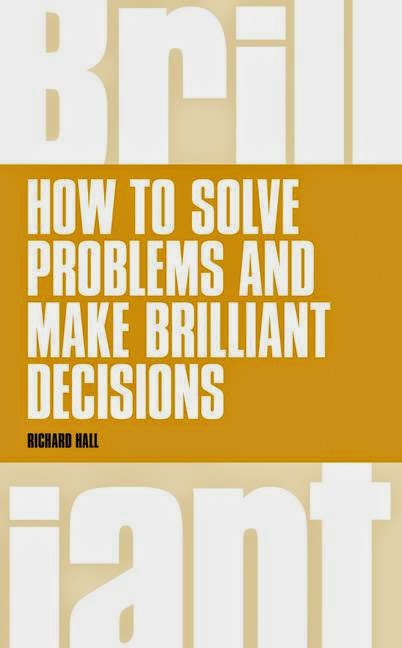
How to solve problems and make brilliant decisions. (Business Thinking Skills that really work)
published by Pearson
Avoid thinking like an ass. An ass was dying in the desert equidistant from food and water. Unable to decide which way to go to satisfy his needs he died. If you know that you have to make a decision and it’s a 50:50 choice about what to do, assess both options and then make a decision. Do not be an ass.
Avoid making up your mind prematurely. The single most common cause of bad decisions is deciding what to do before hearing all of the evidence. It’s hard to resist as our instincts are at work before we are even aware of it. Listen to what the whole story is first.
Avoid inappropriate prevarication. “Stop and think” is good advice. But in a crisis or if you’re in the middle of a motorway with traffic hurtling towards you, rely on your instincts, trust your gut and get a move on.
Avoid being that man in the ivory tower. Do not decide without conferring from others if you want good results from those around you.
Don’t be a dictator. The Duke of Wellington, who led the British Army at the Battle of Waterloo in 1815 became Prime Minister 13 years later. Asked by a friend after his first cabinet meeting how it had gone he said:- “Extraordinary thing but I gave them their orders and they wanted to sit around and discuss them.” The day of the autocrat is over.
Avoid being hungry. As a young man Daniel Kahneman worked in Israel with the Israel Parole Court. He found judges were more likely to allow parole after lunch than before they’d eaten. So do not make big decisions on an empty stomach.
Avoid small numbers. The use of anecdote and small samples “The law of small numbers” is bad practice. How often in the middle of a seriously argued case will you hear someone who’s otherwise very sensible say “well that’s all very well but I recently saw…”?
Avoid being smug about success. Success can confuse thinking and decision making. We remember when we made a great call that really paid off. We always (being human) want to repeat that.
Avoid reducing your chances. Making decisions when you are very tired, jet lagged, drunk or are working in a foreign language is best avoided
Avoid shortcuts, sleeping on the job and short changing – the brain has a brilliant way of taking the easy way out. By:
- Asking ourselves a different, easier question
- Or moving on to something we like doing not this difficult thing
- Or going into mental hibernation like “I’ll sleep on it”
- Or failing to look hard enough. Magicians rely on our faulty eyesight. We see pretty clearly dead in front of us – things that are in the spotlight – but there’s darkness on the periphery of our vision.

How to solve problems and make brilliant decisions. (Business Thinking Skills that really work)
published by Pearson
Labels:
avoid thinking like an ass,
batlle of Waterloo,
Daniel Kahneman,
decision making,
Duke of Wellington,
effective decisions,
Pearson,
Richard Hall,
Richard Hall author,
waterloo
Posted by
Richard Hall
at
08:30
Saturday, 8 November 2014
IF WE CHOOSE OUR BRAINS CAN GROW, NOT DIE SLOWLY
But the computer brain plus a human being’s brain, well that’s another story. The human problem is this: we’re told that our brain cells are dying off at the rate of knots. So as I sit here writing this blog those little blighters are lining up at the mental crematorium in droves. That’s why my writing could in theory get worse and worse as time passes. Worse and worse……
But here’s the good news. Our brains can actually grow too. Research shows that taxi drivers’ brains grow as they do the knowledge – yes, their hippocampuses actually get bigger. The same is true with violists where the part of the brain that operates their nimble fingers of their left hand, grows. Ditto with ice skaters and their sense of balance.
Carol Dwek is Professor of Psychology at Stanford University and her book “Mind-set” is regarded as seminal in its exploration of mental motivation. It’s not only good on this it also talks persuasively about fixed and growth mind sets. We need the latter if we are to really grow our skills. As she says of people with ‘growth mind sets’: “They don't necessarily think everyone's the same or anyone can be Einstein, but they believe everyone can get smarter if they work at it.”
It gets better. There’s strong evidence that as you get older you can get actually more creative.
And writers can write better and better. For example Hilary Mantel is in her 60s; Donna Leon in her 70s: Daniel Kahneman in his 80s and PD James in her 90s.
Daniel Kahneman in action (above) proves it. That the bottom line is simply this. You can train your brain.
And it’s about time we all started doing that so when people ask us “what do you think?” what comes out of our mouths is a considered, thoughtful and useful reply that people listen to and think about themselves.
How to solve problems and make brilliant decisions. (Business Thinking Skills that really work) published by Pearson is coming out on November 12th 2014
Labels:
brain cells,
Carol Dwek,
crematorium,
Daniel Kahneman,
mind set,
Richard Hall,
Richard Hall author,
Stamford University,
the knowledge
Posted by
Richard Hall
at
09:30
Monday, 3 November 2014
HARRIET GREEN SCARES ME TO DEATH
Harriet’s CEO of Thomas Cook. She’s turned a basket case of a company into a Prada handbag. So she’s terrific. But here’s what she said about sleep:
“I don't sleep much, I never have. It's over-rated.”
Apparently she manages on less than three hours a night. Well done her - for now - until she implodes - because life has an ironic way of mugging people who flaunt their alpha-ness.
My advice to you if you want to think and produce thoughtful and carefully created solutions, not plans that are conceived in a daze, is the following:
When I was young, dynamic, thrusting and a greasy pole climber - a thoroughly ghastly person - I was shockingly unobservant, unpunctual but I had a remorseless focus. This is my least favourite word in the current management lexicon (it comes next to passion). That’s when I behaved like Harriet and had 5am meetings just for show.
And then I read Daniel Kahneman’s “Thinking Fast and Slow” where he says:
“…cognitive load is not the only cause of weakened self-control. A few drinks have the same effect as does a sleepless night.”
Harriet do you hear me?
How to solve problems and make brilliant decisions. (Business Thinking Skills that really work) published by Pearson is coming out on November 12th 2014
“I don't sleep much, I never have. It's over-rated.”
Apparently she manages on less than three hours a night. Well done her - for now - until she implodes - because life has an ironic way of mugging people who flaunt their alpha-ness.
My advice to you if you want to think and produce thoughtful and carefully created solutions, not plans that are conceived in a daze, is the following:
- Slow down - most golf swings by the greats look measured and graceful. That’s what we want our leaders to look like and how we them to behave.
- Calm down by breathing deeply and employing (within reason) mindfulness. Clear your mind but don’t empty it.
- Use soft eyes. Sit and look gently into the middle distance letting your unblinking eyes float and go soft. Try it - it’s an ideal mode for deep reflection.
- Then try and widen your angle of vision. Think about a problem and imagine standing above it and doing two things: seeing it in a broader context and also seeing how small or big it is real terms.
- Most of all listen carefully and stand up straight and notice what’s going on around you.
- And sleep. Sleep restores you, replenishes your energy and in your sleep your brain is sorting things out and quite often finding ingenious solutions to intractable problems.
When I was young, dynamic, thrusting and a greasy pole climber - a thoroughly ghastly person - I was shockingly unobservant, unpunctual but I had a remorseless focus. This is my least favourite word in the current management lexicon (it comes next to passion). That’s when I behaved like Harriet and had 5am meetings just for show.
And then I read Daniel Kahneman’s “Thinking Fast and Slow” where he says:
“…cognitive load is not the only cause of weakened self-control. A few drinks have the same effect as does a sleepless night.”
Harriet do you hear me?
How to solve problems and make brilliant decisions. (Business Thinking Skills that really work) published by Pearson is coming out on November 12th 2014
Labels:
alpha-ness,
Daniel Kahneman,
Harriet Green,
Prada,
Richard Hall,
Richard Hall author,
Thomas Cook
Posted by
Richard Hall
at
10:00
Thursday, 30 October 2014
LET YOURSELF GO. THINK.
I hate what the MBA culture has done to Daniel Kahneman’s calls System One, which others call the right brain and normal people call instinct and impulse. I hate business plans which, for the most part are bigger works of fiction than Harry Potter. I hate the endless piles of paper, spreadsheets, analyses and self-serving reports. A friend said “paper plans or paper planes” - right on.
In his brilliant book “Blink” Malcolm Gladwell describes the magnificently effective tool a well-trained gut is. The expert on art who can intuitively smell a fake because “something feels wrong”; the professional card player whose playing behaviour changes before his rational brain notices his impulse to have done so sensing that the cards are stacked; our first impressions which are sometimes but seldom wrong.
All this suggests our desire to balance rationality and intuition, which is (if you think about it) perfectly rational, is entirely wrong. It belongs to the same school of thought that suggests you must dumb down the brilliant to accommodate the mediocre.
Intuition allowed free rein may lead us somewhat astray sometimes and can earn us the reputation of shooting from the hip but our gut feel and our ability to hone it and develop it is our magic bonus.
Where human ingenuity comes in lies in our ability to think hard about whether the instinct that is so strong can make sense and isn’t simply a prejudice or a prejudgement based on previously good experiences. In a word we have great instincts but we are also smart. And we are smart enough to listen and learn. Our skill in learning up to the moment of death is impressively distinctive.
But when they insist you read all that data because therein lies the answer, first of all ask them what they really think about the problem.

How to solve problems and make brilliant decisions. (Business Thinking Skills that really work) published by Pearson is coming out on November 7th 2014
In his brilliant book “Blink” Malcolm Gladwell describes the magnificently effective tool a well-trained gut is. The expert on art who can intuitively smell a fake because “something feels wrong”; the professional card player whose playing behaviour changes before his rational brain notices his impulse to have done so sensing that the cards are stacked; our first impressions which are sometimes but seldom wrong.
Intuition allowed free rein may lead us somewhat astray sometimes and can earn us the reputation of shooting from the hip but our gut feel and our ability to hone it and develop it is our magic bonus.
Where human ingenuity comes in lies in our ability to think hard about whether the instinct that is so strong can make sense and isn’t simply a prejudice or a prejudgement based on previously good experiences. In a word we have great instincts but we are also smart. And we are smart enough to listen and learn. Our skill in learning up to the moment of death is impressively distinctive.
But when they insist you read all that data because therein lies the answer, first of all ask them what they really think about the problem.

How to solve problems and make brilliant decisions. (Business Thinking Skills that really work) published by Pearson is coming out on November 7th 2014
Labels:
Blink,
business plan,
Daniel Kahneman,
Harry Potter,
Malcolm Gladwell,
mba,
professional card player,
Richard Hall,
Richard Hall author
Posted by
Richard Hall
at
08:30
Subscribe to:
Comments (Atom)