Most of us find it really hard to change our minds once we’ve come to a conclusion even when events seem to suggest we might have got it wrong. It simply goes against our psychological grain. Deep down we’ve invested too much time and effort championing an idea or point of view to lightly discard it.
Well, try this if you’re stuck in your opinion. John Maynard Keynes, the iconic economist, asked “when circumstances change I change my mind. What do you do?”
Another good tip to help open your mind and broaden your thinking is for you to see how easy it would be for you to change your mind about something you believe in. I recently heard a story about the late William Rees-Mogg, a man with a brilliant mind who edited the Times a long time ago. He said that he thought, no he was convinced that a given Times leader should say “x”. When politely told that his grasp of the facts were shaky and that in fact “y” was the case, he said, without pausing for breath - “quite so, which is why we must espouse the cause of “y” for the following reasons”.
Now that response is open-minded, flexible and extraordinarily clever (although some might say cynical).
The human race when it feels well informed tends to overconfidence which leads us to nearly all the economic crises we have. It’s overconfidence not greed that’s the enemy of the bank balance.
We tend to forecast boldly but make timid decisions. Think about this the next time you are sitting in front of your forecast spreadsheet. Most of all think this – does my plan match my hopes, expectations and (most importantly) my resources. I bet it doesn’t.
And finally reserve you hardest questions and spirit of scepticism for those regarded as most clever. Often the cleverest are the most intractable. Iain Martin is a political commentator, and a former editor of The Scotsman and former deputy editor of The Sunday Telegraph. He is the author of” Making It Happen: Fred Goodwin, RBS and the men who blew up the British economy”. It has the immortal line in it: ”the assumption was that the ‘new thinking’ made the world safer because it had originated from such clever people.”
In a messy, paradoxical world, nimble mindedness matters more than ever.
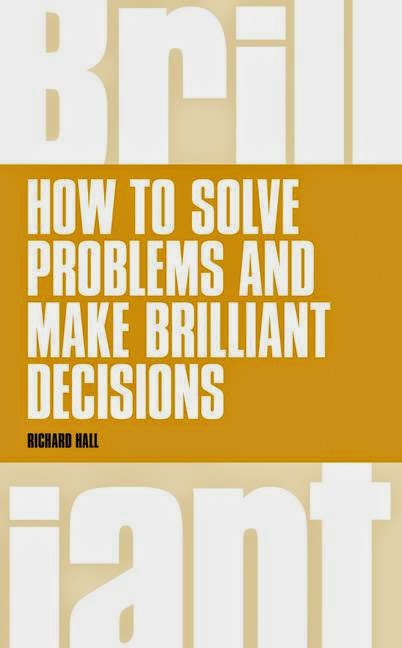
How to solve problems and make brilliant decisions. (Business Thinking Skills that really work) published by Pearson is coming out on November 12th 2014.
How to solve problems and make brilliant decisions. (Business Thinking Skills that really work) published by Pearson is coming out on November 12th 2014
Showing posts with label Iain Martin. Show all posts
Wednesday, 12 November 2014
CHANGE YOUR MIND WHEN THINGS AROUND YOU CHANGE
Labels:
changing minds,
economist,
Fred Goodwin,
Iain Martin,
John Maynard Keynes,
Richard Hall,
Richard Hall author,
The Times,
William Rees-Mogg
Posted by
Richard Hall
at
08:30
Monday, 13 January 2014
BEWARE FAT LADIES AND ORANGE JUICE
I’ve been reading Iain Martin’s book called “Making things happen” which is about the collapse of the RBS Banking Group. It’s a bleak read because it interprets what happened with step by step superciliousness.
I’m sure Iain is a very nice man. I think he’s a clever one too. But his huge antipathy towards Fred Goodwin makes the book bloodless. Surely Goodwin was just more interesting and complex than this. In contrast read Walter Isaacson’s biography of Steve Jobs to see how a bully can be described.
“It aint over till the fat lady sings” was a line originated by Ralph Carpenter of the Dallas Morning News in 1976. Carpenter (possibly a Wagner lover thinking of Brunhilde) was writing about an American Football match.
In his book Martin has an elephant in the room in every chapter whom no one seems to notice. It’s that fat lady clearing her throat and opening her sheaf of music. And yikes, she’s about to sing. I’m a bit surprised that the cast of bankers, regulators and politicians hadn’t been deafened by the sound of preparatory humming she was making.
But in most situations we face in business we seldom encounter such perfect storms that the banks faced in 2008. We just face a demoralising prospect of decline, desperation and demise. Yet the solution is to get in there before the fat lady puts on her glitzy dress and mount a planned and sustained sales drive. Cost cutting alone never does enough. You have to do something systematic about the weakening top line. Fat ladies can’t sing when you’re hitting your sales budget.
And talking a bit more about fat ladies there’s a recent novel piece of demonization. Sugar. In the 1960s Professor John Yudkin wrote a book called “Pure, white and deadly” which put the root cause of fat ladies down to their eating too much sugar. He lost that argument and fat instead became the enemy. But the devil sugar is now back under the microscope.
And I hear that fruit is bad for you, it’s full of sugar - crammed with the wretched stuff, and fruit juice is worse than Capstan Full Strength. As for five a day, forget it. And chocolate? The “c” word is no longer crack cocaine – it’s Cadbury.
What I love most about human beings is our ability to change our minds and turn heroes into zeros and vice versa. If I were Fred Goodwin I’d launch a confectionery brand – what’s to lose?
Most of all I love our ability to re-group, prove our resilience and face down fat ladies with songs in their hearts and tell them that they will not be required, thank you.
Labels:
American Football,
Brunhilde,
C word,
cocaine,
fat lady,
Iain Martin,
orange juice,
RBS,
Wagner
Posted by
Richard Hall
at
06:00
Subscribe to:
Posts (Atom)


