Showing posts with label Ed Miliband. Show all posts

Monday, 22 June 2015

'ART, WHEREFORE ART THOU?'

I’d like to claim these words came from the second merchant called Biennale in Shakespeare’s lesser known “Merchant of Venice 2” but I can’t and it doesn’t.

But neither it would seem, does art play much of a leading role in La Biennale di Venezia – the 56th International Art Exhibition. The critics have been cruel about it. Respectively the Guardian, Telegraph and Times:

“More of a glum trudge than an exhilarating adventure”

“Hectoring and joyless”

“Why Venice should be allowed to drift slowly towards a dignified death”

Not ringing praise then and to be fair the Biennale’s title “All the World’s Futures” deadens one’s expectations with its sententious pomposity.  Why is it artists speak in a language (which I call Sewellese) that is excluding, abstract and just weird?
The Czech and Slovak Republic Pavilion slogan…inspiring thought!

Either that or they distress themselves by the foulness of capitalism (and they do this in Venice the very origin of a rapacious love of money), of inequality, cruelty, war and so on. Life seems bad to the artists of today. Ironically all this sits alongside some of the most joyously uplifting works of previous centuries in the galleries in the heart of Venice like the Academia, Ca Pesaro, Ca D’Oro and the Correr.

The Swiss Salon on the Zattere proclaims:  “The World’s in a Hell of a Mess” (is it? Well look harder), New Zealand examines “Psychological Blocks of Perception” and throughout the city there are fragments of letters of complaint by victims of torture in Iraq. Any second I expect to see Ed Miliband walk round the corners and say “see what I mean?” Phrases like “Present Nearness” from Grenada (no me neither) leap out of posters. It’s like being trapped in Pseuds Corner.

The actual Giardini event is vast. Things to like – yes in a messy world let’s look on the brighter side at last.


The giant live, helmeted, masked fighter pilot’s head with breathing kit at the entrance to the Russian stand is dramatic.

The intricate vast spiders’ webs of keys hanging from the ceiling and their videos of tiny children from around the world talking about where babies come from (“I came out very fast….. vroom…”)  in the Japanese stand was memorable.


The US stand of which I’d heard good things was just dull.

If you like Spam, cigarettes and female orifices you’d love the UK stand….some said it was “funny”.
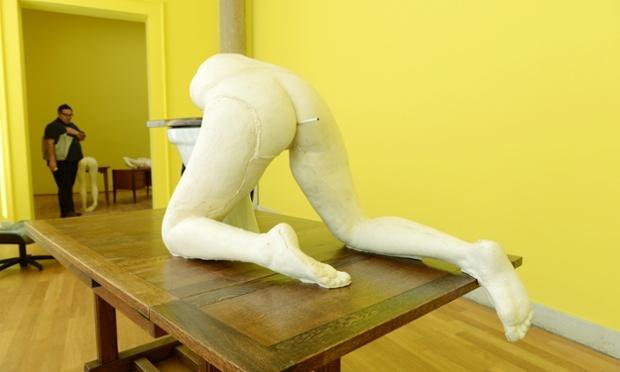

But Fiona Hal’s work and ideas on the Australian stand was three star Michelin art. In six or seven sections it was witty, beautiful and thought provoking. She’d engaged some Aborigine women to work as a team creating soft toy endangered animals out of military battle fatigues and military waste….it was extraordinary. One wall was covered in a display of driftwood from a river in New Zealand – strange and beautiful.


The Australian girls on the stand were serious and very articulate.

Australia and Fiona thank you. I believe in art and the Biennale again.

Monday, 29 July 2013

THE ELEPHANT IN THE ROOM IS FOREIGN


The elephant of course is the EU which, having been heavily exercised in the Spring, now appears to have bored politicians, The Tories have sprinted off on their holidays in fine spirits after seeing DC beat up Ed Miliband in the Commons and then being fed burgers at No. 10. Quite simply elephants have stopped being important.

Yet an “in-out” referendum will determine our grandchildren’s lives. And the debate, in so far as there has been one or ever is one in the political forum, is neither particularly rational or thoughtful.


It’s clouded with prejudice, short termism and narrow self-interest. Too much bluster, not enough calculation.

Even Matthew Parrish, not unknown for saying what he thinks, confesses he just doesn’t know what to think when it comes to Europe.

We start from the fact that many of us simply don’t seem to like foreigners at all. It’s in our DNA. And the Europeans are the most convenient to dislike.  And then we seem short of the skills which we used to have and which inspired that board game “Diplomacy”. I’ve been watching the “White Queen” on BBC TV and listening to Philippa Gregory and others on the Wars of the Roses and the purposeful way the major players of that time worked out how to secure advantage.

Give Margaret Beauford, Elizabeth Woodville or, a few years later, Thomas Cromwell the situation we face and they’d come up with a somewhat more creative solution than one involving taking your bat and just leaving the game. (Machiavelli from about the same era would have loved it too.)


All our competitors have been seriously weakened by recent events, particularly France, but also Spain and Italy and even Germany. Meanwhile Britain stands in reasonable stead with  an economy on the upturn and  reputational kudos through a good Olympics, recent great sporting successes, London being acknowledged the capital city of the world as is our status as the global arts centre.

Weak competitors mean it’s time to advance not to retreat.

If we choose we can be a real lead player inside Europe helping Germany re-construct it. Our 15th and 16th century strategy role models would unblinkingly have seen the opportunity of advancing Britain by such a powerful alliance.

When it comes to being rational I have to imagine that the vast majority of businessmen who want us firmly in the centre of the EU represent left brain thinking. Why would they say this if they couldn’t see how important it was?


(Incidentally I thought a potent downside of separatism was well expressed by a top Scot who confided that wealth and talent would flood out of Scotland if independence were to be voted in there.)  And it’s not just the world of business. Ask America or Japan (and probably China and India too) and they’re mystified why we aren’t striding up to the Board Table as the player to replace the role the waning and woeful France once had.

Britain at 1% of global population isn’t a great world power any more but it’s a great European power.

That’s where we can exert real influence and where we’re needed.

Those who disagree probably take a similar view of social media…they don’t like it, understand it or even want it. They say they’ll ignore it and that it’s not that important. Yet 93% of business use it in their marketing and, like it or not, Facebook, were it a country, would in terms of population be the third largest in the world.

The elephant can’t be ignored.

The debate may be tough and nasty.

But a bit of a thoughtful punch up is better than potentially acceding to a generation or so of isolation and decline, isn’t it?

www.colourfulthinkers.com