Monday, 28 October 2013

WHY BOTHER GOING THE EXTRA MILE?

In the heady world of management self-improvement books, or the sort Daniel Pink writes, the theory of trying to “achieve 110% performance, of exceeding customer expectation and not just pleasing but delighting customers” is rife.


Occasionally when you are shopping you encounter recently coached behaviour from retailers that is so exceedingly welcoming you wonder if the shop assistant may not have taken a sudden libidinous fancy to you. It can be very alarming to be the victim of “customer delight”.


The Creative Director of Noggin who coach major companies in customer service, amongst other things, recently had a strange encounter at a workshop. He was advocating the power of building customer relationships when a young man on the workshop said:

“I can’t see the point of all this.”
I imagine there was the sort of silence when someone says something like “Hitler wasn’t all bad” or “climate change is actually a myth” or “a woman’s place is in the kitchen.”
Heresy is hard to take. Had this character been feline he’d have looked like this:


Apparently he went on:
“I work for an events company and I recommend locations. If it’s one a customer wants, can afford and the availability is OK he books it and I move on…he has no interest in my personality or anything else. He’s got what he wanted: job done.”

Despite persuasive debate he was immovable. His view was that you present the deal, close it and move on. All this going that extra mile was a daft as Mo running an extra lap or driving your team hard when they are 3-0 up and the game’s almost over. He was a creature of online shopping rather than shopping at Selfridges.


I was reminded of actor Simon Callow’s story about reading a bedtime story to his God children. He described pulling out all the stops with dramatic voices. His God daughter tugged at his sleeve and whispered “do it simpler.”

Good for her. Nearly always less is more. But not when it comes to manners, human feelings and brand building. The Apple store is about much more than naked transactions as is Nike Town as is the new Lego store in Brighton.


Not everything is a click away from a sale.

I recently heard a Chairman of an advertising agency lamenting the universal use of text or e-mail to communicate with clients. When you are going to be late or more expensive than you’d thought or you’ve mucked up then a face to face meeting or a telephone conversation might do the trick. An e-mail usually does just the reverse.

The issue is not whether you are going the extra mile.
It’s whether you’ve actually completed that mile race in the first place.


Monday, 21 October 2013

WHY I LOVE LOOPHOLES

One of the smartest men ever to work in advertising was Bill Bernbach. He said that the admission of a small fault would gain you trust that you were a truthful sort of person. Bill was praising the loophole, or rather the need to admit it and the benefit from doing so.


Truth of course is much in the news right now – the Police, Orchid View Care Home and the KPMG HS2 report on the zero sum effect of the project…apparently its loophole is it’ll damage the economy of places to which it isn’t going.


Today when everyone is counselled to whistleblow it’s disappointing that Lisa Martin who called in the police to Orchid View exposing a horror story has been unable to get a job since.

And if you want to succeed as a policeman watch other colleagues’ backs, smooth over the loopholes and play for the team. I’m not defending the Plebgate guilty, merely observing that they acted, all of them, true to their collegiate and Freemasonish culture.  Imagine a premier league striker stopping a game to confide in the referee that a team member had “dived deliberately” in the penalty area.


The likely consequence, I imagine, would be the whistleblowing footballer would be sent off by the irate referee, fired by his club and beaten up by his agent.

Truth, as Pontius Pilate discovered, is tricky stuff.

And again as we saw in the hostile interrogation of the HS2 CEO, Alison Munro by Gavin Esler regarding the failure to broadcast all the data in this recent report.


What the appalling Esler did is switch me (and I suspect others) from sceptic about HS2 to fervent supporter on the basis that if he can be so horrid he must be against it for bad reasons.

The perception of truth is about its presentation as well as facts.

In my imagination I see Esler interviewing Asa Briggs Candler, the marketing genius at the birth of today’s number two brand, Coca-Cola:

“So does it contain traces of the banned substance cocaine?…do you refuse to answer?....Well what are the ingredients?...What do mean it’s secret?. …why are you hiding the truth?...and does it dissolve human teeth if they are left to soak in it for 24 hours?...come on answer…you will be judged by your silence.”


Coke is a winner and you Mr Esler will be judged by your manners.

Life is not neat and tidy. It is not a thing of perfection. There are loopholes.  And the desire to have a cut and dried, cast iron, irrefutable story is going to lead to being economical with the truth.

Remember what Bill Bernbach said and disarm your opponent with a small admission and keep smiling. On balance you’ll win more victories that way.

Monday, 14 October 2013

HOW MUCH IS IT WORTH?

I keep on meeting ex colleagues and so-called marketing experts who rather like defrocked priests seem to want to confess they’ve lost the faith. They look at me with embarrassment and confusion on their faces and say “it’s all bollocks isn’t it, isn’t it?”


A career in advertising and brand management and they’ve lost their belief, all those years in brand prayer and suddenly they’ve become marketing atheists. But of course it’s always been all right to have doubts especially when the language of marketing has been purloined by non-marketeers and especially the media.
Anyone would be confused to hear people talk about the UKIP brand or brand Russia or the Linda Barker brand – she used to talk about herself as LB  not as a person at all, an image, a brand  – for heaven’s sake – an icon.


This week I happened, in the interests of curiosity rather than penury, to visit Poundland and Lidl. Both are doing brilliantly right now and deservedly. They’re great value and they have brilliantly clear positioning. “We are cheap” they say and they are.


 But in either you learn the value and reason for brands, those products with the swagger of superiority like Innocent or Apple or Dom Perignon. There is, of course, no problem with these stores or Aldi which increasingly cater for the Waitrose shoppers in us when we awaken lean, hungry and overdrawn. Our left brain guides us to smoked salmon, napkins, ketchup and chocolate which is just fine and does the job. Eat it and your self-esteem, health and complexion will not suffer.

But there’s more to life than crisps from Estonia at £1.09 rather than £2.50 from a start up in Stoke Poges where the owner has dreams about potatoes and would kill you if you teased him or her.

Earlier in the week I was in Selfridges trying to get my Mont Blanc pencil mended. To my horror I see it’s more than doubled in price from the ridiculous £130 it cost a few years ago. I’m told it cannot be mended here but has to be sent to Germany where it will be assessed and a quotation phoned to me. This whole diagnosis, estimate and complex restoration process (should I care to comply) will take four weeks.


 This is contemptuous luxury brand marketing at its best. But despite myself I can’t resort to a W.H. Smith pencil or a Bic….despite myself I love my Mont Blanc in the way others love their iPhones.
The real truth about marketing and the creation of brands is they cost more because they are better and, more importantly, although they are not that much better, they have a better story to tell about why, how, where and when they are crafted.

Most marketeers have their focus wrong. They need to worry a lot more about the quality of their product than their marketing.

But they also need to remember that in shops like Lidl, brilliant as they are, there are no stories, there’s just stuff.

Monday, 7 October 2013

YA BOO SUCKS

I came back from what turned out to be a slightly longer summer break than I’d intended feeling genial. Genial is an old fashioned sort of pork pie, pint and pickles word – genial is not about being pleased with oneself but it’s having that feeling  of viewing  life in a calm, tolerant and good-natured way.


Even the news about the economy was better and the long term forecasters, genially in praise of population growth, suggest that going as things are we’ll be the no. 2 economy in Europe soon and even possibly overtake Germany by the middle of the century.

So what’s not to smile about?

Quite a lot apparently if you are a member of the far right anti-Europe Tory brigade, the Tea Party in America or the Golden Dawn in Greece (notice how I’ve willy-nilly thrown together these unhappy bed fellows into the grumpy sleeping bag.)

This right wing crowd are characterised by extreme bad manners, a refusal to play by the rules and a strong sense of self-righteousness. Most of all they won’t take no or even yes for an answer – they all have to have the last word. So you might say they are behaving in quite a childish way.


This makes me speculate that Mr Cool - Barack Obama – who is calmly saying “no” at present, probably wishes he lived in Greece because what he’d do then is lock the Tea Party up, ban them and pretend they didn’t exist.

Is he lacking in leadership? Well he isn’t a Thatcher or a Churchill or a George Bush for sure. But all of them were actually pretty unpopular from time to time in their day.

It’s been argued that the absence of leadership – so widely lamented – is partly due to a failure of “followship”. We, the electorate, have become unherdable cats or horses (if you prefer) who, when it comes the crunch, won’t drink.


And modern media adds to the trouble because wrong and right both demand and get equal billing, so it’s really difficult to keep focused on principle and stay calmly on the track you promised.

Especially as Armageddon beckons.

And finally Luke Johnson – who created Pizza Express and writes insightfully on management has lambasted the far from genial Lord Sugar and the crowd on Dragon’s Den. Their behaviour is inhibiting a new generation of entrepreneurs because witnessing the witless and greedy being torn to shreds by the cruel and rude is not what they want from their lives.


It seems to me a bit of geniality all round might not go amiss. I’m not going to align with the band War’s song “why can’t we be friends?” but it really seems endless playground confrontation is becoming  tiresome and unproductive.

So there.

www.colourfulthinkers.com

Monday, 30 September 2013

WHY ARE BUSINESS PEOPLE SO NASTY?

It’s the sort of question that a grandson might ask having listened – having nothing better to do – to Ed Miliband’ s speech at the Brighton Labour Conference.  There the small and unsuccessful were lauded but the bigger and makers of more “p….”


(hiss the word quietly my dear for it’s a word that cannot be said) more “profit” …. were to a man – mostly men – because there are very few women at the top of business – rotters.

John Cleese put it like this:
“I find it easy to portray businessmen. Being bland, rather cruel and incompetent comes naturally to me.”


Businessmen have been typified by Messrs Goodwin, Diamond, Sugar, Green and a yo-ho-heave-ho of Russian pirates…all, were we to imagine them as alumni of Hogwarts, members of Slytherin – rather sleazy and slick and sarcastic.

But isn’t that a little disingenuous and unfair?

The media just don’t like business although they are discovering, to their liberal chagrin, that Generations Y and Z do. Research by You Guv shows “they take more pride in British business than the Welfare State and give Google, Apple and O2 credit for improving their lives”. (The Times 18/9/13)

Applications from them to advertising agencies are flourishing. The likelihood of these young people going on an anti-capitalist march is low. Enterprise and entrepreneurship are actually sexier than they’ve been for some time.  It’s the word “businessman” that, in its old fashioned way, summons up images of pinstripe, furled umbrellas and middle class white men. Think ideas, think dirty hands, think midnight oil, think trial and error, think global excellence …that’s the new world of business.

Bland?  Certainly not.
Cruel? No more than competition ever is.
Incompetent? Just try doing it yourself, John. You’ll find it isn’t that funny when the alarm rings at 4.00am, your flight leaves at 6.30 and you have a day’s work to do on top of pitching an idea to a German who is likely to say “no”.

Business is seldom about chatting over lunch in the Savile Club for Generation Y. It’s a Starbucks in a paper cup and a bagel.


Lunch? Lunch is for wimps.

But what some may find antipathetic is that business now works to global rules.
And this applies to ethics too. (Incidentally I heard one of the church commissioners talking about their 10% stake in the new “Ethical Bank” that’s being constructed out of RBS. The history of the church has not exactly been brimming over with ethical concerns itself and isn’t the concept of an ethical bank a little like that of a compassionate abattoir?)

Overall you can’t regulate innovation. Business has to find its own level and  markets have to be allowed to work.

We should stop trying to herd cats and we should avoid business clichés.

The more I see of young people in business the better I feel about the new tougher breed of competitor.
As many of them are women as men and nearly all of them deft and hard-working.

Nasty?

Now you should see the politicians. Kevin Spacey in House of Cards is nothing….


Friday, 27 September 2013

THE CIRCUS COMES TO TOWN

I suppose why my heart sinks a bit at the prospect of the Biennale – the 55th International Art Exhibition in Venice – is because it reminds me so much of old fashioned sales conferences – large budgets, the need to impress and a big venue.
In the Ca’ Pesaro there’s a work by John Baldessari, a canvas blank but for these words:
“Everything is purged from this painting but art, no ideas have entered this work”.
In the Biennale it’s just the reverse…all ideas but I’m not sure about the art.

 
Thus the Spanish stand has as its entry just a huge heap of rubble – yes - a metaphor for their economy.

The United States has sculptures made from rubbish, old bags of cement and assorted debris with officious girls saying - “don’t get near, stand behind the line”. Finland has trees and a tribute to photosynthesis. Korea’s included a dark room in which there was no light and no sound for sixty seconds. In there I had an overbearing desire to say “will you take your hand off my bottom?” to see what happened, but I resisted the urge.

The Dutch stand with human faces crushed in printers’ presses, the Japanese reliving crises like their tsunami in a series of sections entitled “precarious tasks” and the British stand were all  successes amongst others.

Jeremy Deller, the installation artist, had done Britain proud in recognising the stand had to be engaging and vivid. The exhibit of portraits by prisoners (mostly ex-soldiers) of significant people involved in the Iraq war was amazing.  Elsewhere he declares ‘war on wealth’, as the Guardian eagerly described it. The counterpoint of William Morris and the rouble-drenched Abramovitch was good and angry as was section all about the Prince Harry who allegedly once shot a harrier hen at Sandringham.


They were even serving mugs of tea on the stand.

The scale of the event overall is theme-park vast and tiring which meant when I belatedly reached the British Tino Seghal performance art piece which was the gold award winner of the whole show my mind was so battered that it seemed incomprehensibly weird. But Alva Noé from Cosmos and Culture said - and this made sense as I reflected on the sheer presence of the piece:
“this work doesn't play the "attention" game that is so basic to the performing arts. It doesn't try to capture your attention, or direct it, or organize it. The work is just there, like a picture on the wall, and the actors might as well be battery-operated machines.”


In my head I hear a chorus of voices muttering “philistine” in my not lavishing more praise on the Biennale but this is a show and about as far from the Guggenheim, Academia or Pesaro as you can get. Until as you limp away from the Giardini you reach the biggest art show in the history of mankind which is in the Arsenale. By now the chorus of voices in my head are whimpering “enough, enough!”

Bur first an old friend – no surely that isn’t the right word – a display entitled “The Universal Addressability of Dumb Things” by Mark Leckey last seen by me at Bexhill on Sea at the De La Warre Pavilion. It seems out of place rather like seeing a London cab in the streets of Venice.
But then briefly two extraordinary moments for art anaesthetised eyes – the Peruvian exhibition of spices which touched the senses strongly and looked great and Pawel Althamer’s “Venetians” – a mass of skeletal sculptures of people with skinless bodies. Extraordinarily he’s produced these in association with his father’s plastics factory using extruded strips to form the surreal bodies. He says it’s to show “bodies are just vehicles for the soul”. It makes you stop, look and think. I thought it marvellous.


The Biennale is a huge success. It’s a hotch pot of “wow”, “yuk” and “what the hell is that?” Creativity, pretension and political raging co-exist but what it feels like is a big, important and inventive event.

If only the literature and marketing of the event were as good and clear as the best of the work is. At least Jeremy Deller shows the way how to do it in his brilliantly communicative work. Let’s see if they heed my words in 2015…it would make my life so much less tiring.

Wednesday, 25 September 2013

THE BIGGER THE BETTER


Having just spent two weeks in Venice – a small place with an indigenous population of around 60,000 I couldn’t help reflecting on the old Latin maxim “memento mori”. Broadly this means “remember death” or (more colloquially)”watch it cock this won’t last”.

Well it didn’t last that long for Venice.

In the late 14th century they had 180,000 living there - three times the size of London, it was the most powerful city in Europe, with 36,000 sailors, over 3,000 ships, (and en passant 20,000 courtesans), it was the centre for printing presses (so the silicon valley of the world then), trade nexus of the world, was populated by polyglots, renaissance men and women, was a true republic and  about to become the artistic and cultural capital of the world.


It was the Apple, Google and Amazon combined of their day…and then some. You didn’t get bigger than Venice.

Michael Geogehan, one time briefly CEO of HSBC (“memento mori Mike”) wryly observed it had been the banking centre of the world and was now just a water attraction.

I remember thinking that when, as it will, HSBC fades away no one will think it worth more than a footnote. Venice, on the other hand, has left, in its very presence, a wonderful legacy that allows us to see “memento mori”, as it were, made flesh.

Most of all Venice is proof that big is not beautiful but that unreasonably good is.

Last week I watched the topplingly-high Costa ships easing in to berth at Venice and thought “your time is over buddy”. The Costa Concordia crash and the economy has dented Carnival’s profits and they all looked rather empty.


Big is not beautiful.

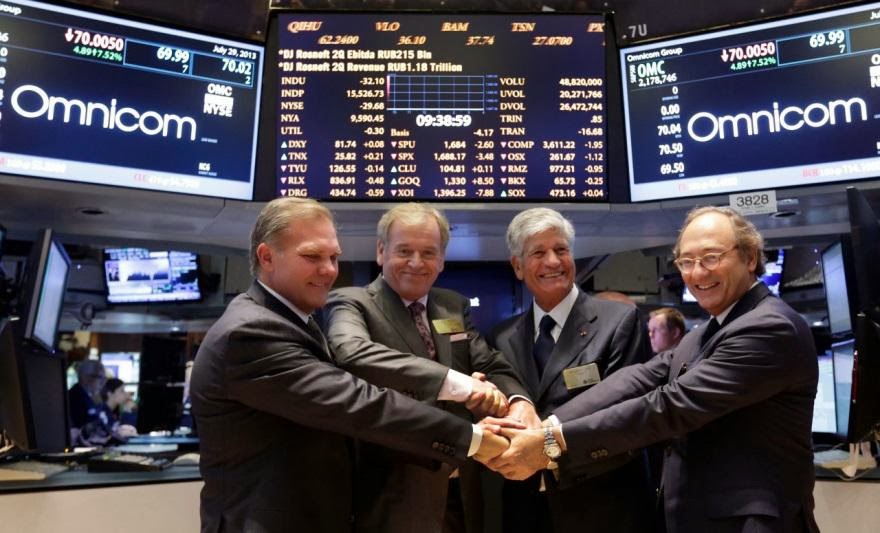
The advertising equivalent of overlarge cruise ships, Costa Publicom - the merger of Omnicom and Publicis - seems similarly pointless and with a built in “wallow”.  Because the word to attach to the bigness mania is “wallowing”.


On Newsnight recently we had confirmation of one guru’s view of the subject. Harvard Professor Clay Christensen on tech firms failing to innovate: "Nokia is essentially gone, BlackBerry is essentially gone and now Apple is next".

Apple is wallowing.

He described the fact that innovation was slowing down as companies were sitting on outdated technology or capital investment.  Apple’s closed architecture will kill it, he said, using elaborate hand movements.


Meanwhile Tesco and the rest of the retailers are sitting on dinosaur out-of-town hypermarkets, the big accountancy firms are like cruise liners looking for negligence-malpractice icebergs.

I wonder - haven’t we learnt from the big car company fiascos?  Big is not beautiful.

Returning to Venice…it still retains its power but in a different way.

Its power is over our souls.

Being engaged by timeless worth is beautiful and inspiring and Venice has it. Water attraction indeed….only a banker could get something quite so wrong.